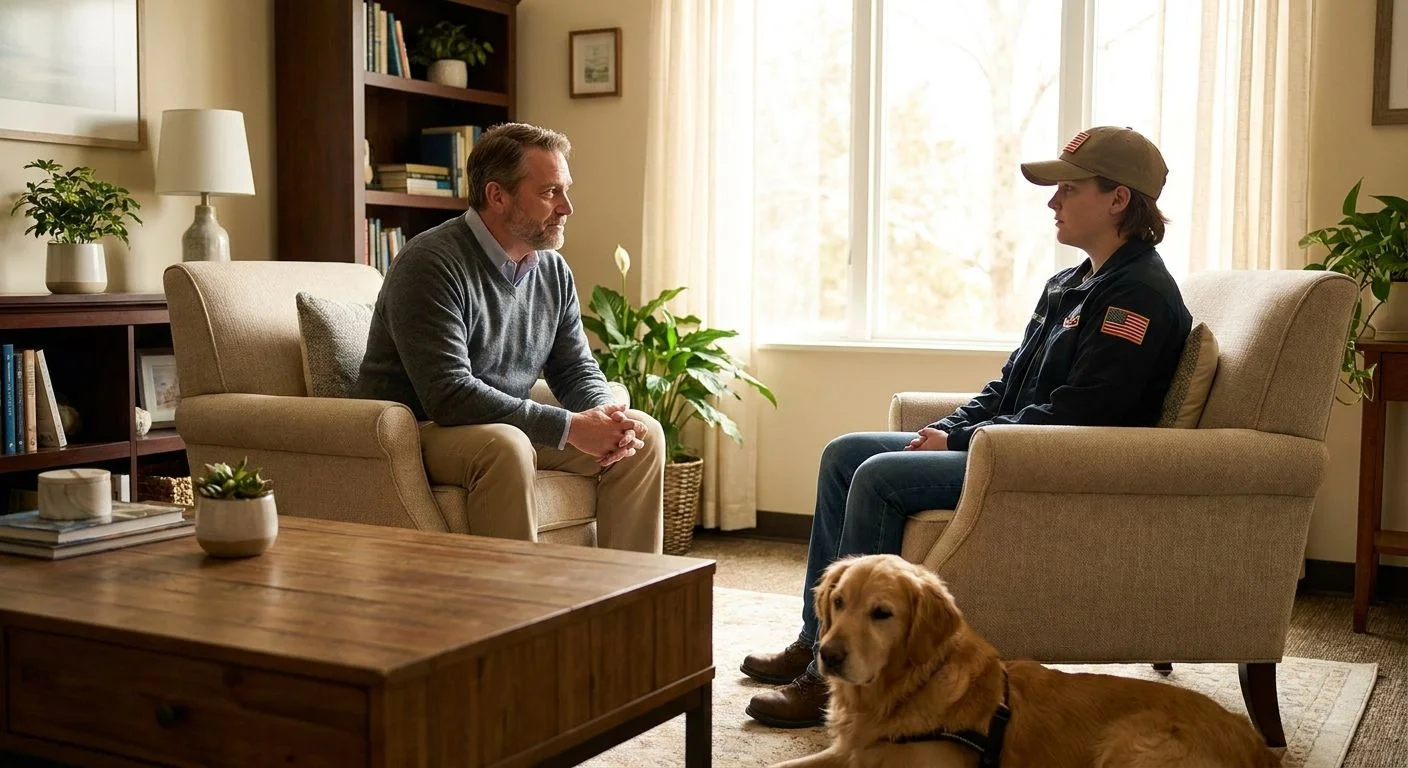
If you carry the job home — the hypervigilance, the disrupted sleep, the flatness that shows up around people who've never seen what you've seen — individual therapy built for veterans and first responders addresses that directly, not as a generic anxiety complaint.
- Therapy for veterans and first responders works best when it targets occupational trauma exposure, not generic stress management.
- Sleep and hypervigilance carryover from shift work is the most common entry point into individual therapy for this group in 2026.
- Peer support groups alone are a Skip once trauma symptoms are active — pair them with individual therapy instead.
- Structured, skills-based approaches like CBT outperform open-ended talk therapy for occupational trauma. Buy.
- Brandon Boorsma Counselling in Lethbridge offers individual therapy suited to shift-based schedules and trauma-adjacent presentations.
Why this matters
Generic anxiety therapy assumes a client whose nervous system reset each night. That assumption doesn't hold for someone coming off a 12-hour shift or a 24-hour rotation with adrenaline still circulating. Veterans and first responders present with a specific cluster: hypervigilance that looks like anxiety but has a different trigger, sleep that won't settle even off-shift, and a professional culture that treats asking for help as a liability. A therapist who doesn't understand that context will spend the first several sessions re-explaining what should be obvious on day one.
Brandon Boorsma Counselling, based in Lethbridge, Alberta, works with individuals navigating exactly this kind of occupational strain alongside more familiar presentations like anxiety and depression. The starting point matters more than the label on the intake form.
Who this is for
This guide is for currently serving or retired military members, police officers, paramedics, firefighters, correctional officers, and dispatchers in southern Alberta who notice the job following them home — irritability with family, trouble winding down after shift, or a growing sense of numbness they can't name. It's also for spouses and partners trying to understand why standard advice ("just relax") isn't landing. If you're managing symptoms that started or worsened because of the work itself, the criteria below apply to you more than a general "find a therapist" checklist would.
What to look for in therapy for veterans and first responders
Comfort with occupational trauma exposure
A therapist needs to be able to sit with detailed accounts of critical incidents without flinching or redirecting to something softer. If the clinician seems more comfortable talking about work stress in the abstract than the specific incident that's replaying in your head, that's a mismatch. Occupational trauma has a different texture than generalized worry, and treatment has to start there.
Flexible scheduling around rotating shifts
A 9-to-5 appointment grid doesn't work for someone on a three-week rotation or 24-hour on-call blocks. Scheduling flexibility isn't a nice-to-have here — it's the difference between someone attending consistently in 2026 and dropping off after two sessions because the slot conflicted with a callback.
Skills-based, structured treatment over open-ended talk
Cognitive behavioural approaches give you something concrete to practice between sessions: reframing intrusive thoughts, managing physiological arousal, rebuilding a sleep routine disrupted by shift work. Open-ended talk therapy can feel unproductive to someone used to task-oriented environments, and it often takes longer to show measurable change.
Confidentiality that respects rank and culture concerns
First responders and veterans worry, reasonably, about how seeking help might be perceived by supervisors or colleagues. A therapist who understands that concern builds trust faster than one who treats confidentiality as a boilerplate disclosure.
Attention to the relationship and family ripple effects
Hypervigilance and emotional shutdown don't stay contained to the person carrying them — partners and kids absorb the fallout. Therapy that at least acknowledges this, even in individual sessions, tends to produce change that holds up at home, not just in the therapy room.
Local, accessible delivery in southern Alberta
Proximity and format matter when someone is already managing an unpredictable schedule. In-person sessions in Lethbridge remove one more barrier for people who'd otherwise let the appointment slide.
Book individual therapy in Lethbridge
Sessions built around shift schedules and occupational stress.
Where to start, based on what's actually going on
The pick for the 3 a.m. wake-ups. If shift work and hypervigilance have wrecked your sleep, individual therapy for anxiety-related insomnia targets the loop where a racing mind keeps you from resting and poor rest keeps the mind racing. One concrete marker: if you're averaging under five hours of consolidated sleep for more than a few weeks running, that's the priority to treat first. Buy.
The pick for chronic exhaustion that isn't just tiredness. Rotating 12-hour shifts and repeated exposure to high-stress calls produce a specific kind of burnout — flat affect, dread about returning to work, irritability that surprises even you. Therapy for work-related stress and burnout is built for that presentation rather than generic workplace dissatisfaction. Buy.
The pick for the identity shift. Retiring from service, transitioning out after an injury, or moving from active duty to a desk role changes more than your schedule — it changes how you see yourself. Individual therapy for major life transitions addresses that identity disruption directly instead of treating it as a footnote to anxiety. Consider — best fit once the acute crisis phase has passed and you're dealing with the "who am I now" question.
The pick to skip if trauma symptoms are active. Peer support groups have real value for normalizing what you're going through, but they aren't a substitute for individual treatment once symptoms like flashbacks, avoidance, or panic responses are interfering with daily function. Group settings alone, without an individual therapist tracking your specific symptom pattern, is a Skip at that stage — pair the two instead of choosing one.
What to avoid
- Wellness apps as a first-line response. Breathing exercises and mood trackers help maintain gains, but they don't address occupational trauma exposure on their own.
- Therapy that pathologizes normal shift-work symptoms. Some sleep disruption and irritability are expected consequences of rotating schedules, not automatically a disorder — a good therapist distinguishes the two instead of over-labeling.
- Waiting for a crisis to book the first session. The presentations above tend to compound quietly for months before they force a decision. Earlier intervention in 2026 costs less in disrupted relationships and missed shifts than waiting until a breaking point.
Verdict comparison
| Pathway | Best for | Verdict |
|---|---|---|
| Individual therapy for anxiety-related insomnia | Sleep disruption tied to shift work and hypervigilance | Buy |
| Therapy for work-related stress and burnout | Chronic exhaustion from repeated high-stress exposure | Buy |
| Individual therapy for major life transitions | Retirement, medical leave, or role change from service | Consider |
| Peer support groups only | Normalizing experience, not treating active symptoms | Skip |
FAQ
What’s the best type of therapy for veterans and first responders?
Structured, skills-based approaches like cognitive behavioural therapy tend to work best for occupational trauma and hypervigilance in 2026, since they give concrete tools to use between shifts rather than relying on open-ended talk alone.
Is individual therapy better than peer support groups for first responders?
Individual therapy is better for treating active symptoms like flashbacks or panic responses, while peer support groups are better for normalizing the experience. The two work well combined rather than as an either-or choice.
How much does therapy for veterans and first responders cost in Lethbridge?
Pricing varies by clinician and session format, so check current rates directly with the practice you’re considering rather than assuming a flat number.
Can therapy help with hypervigilance and sleep problems caused by shift work?
Yes — targeted approaches that address both the physiological arousal and the disrupted sleep schedule tend to produce faster improvement than generic anxiety treatment alone.
Do I need a formal PTSD diagnosis to start individual therapy?
No, a diagnosis isn’t required to begin therapy. Many people start treatment for symptoms like irritability, sleep trouble, or emotional numbness well before any formal diagnostic process.
How soon should a first responder start therapy after a difficult call or incident?
Earlier is generally better. Waiting until symptoms compound over months tends to make treatment longer and harder than addressing the response while it’s still fresh.
What’s the difference between counselling and therapy for occupational trauma?
In practice the terms are often used interchangeably, but occupational trauma work specifically requires a clinician comfortable with detailed critical-incident material, not just general life-stress conversation.
One last thing
The symptom that gets first responders and veterans into a therapist's office is almost never the trauma exposure itself — it's the fallout at home. Partners noticing the shutdown, kids getting the short temper, sleep finally breaking down enough that function at work starts slipping. If any of that sounds familiar heading into 2026, that's the signal to book, not a reason to wait until it gets worse.
Related guides
- Individual therapy for anxiety in Lethbridge
- Individual therapy for grief and loss
- How to recognize signs of depression in yourself