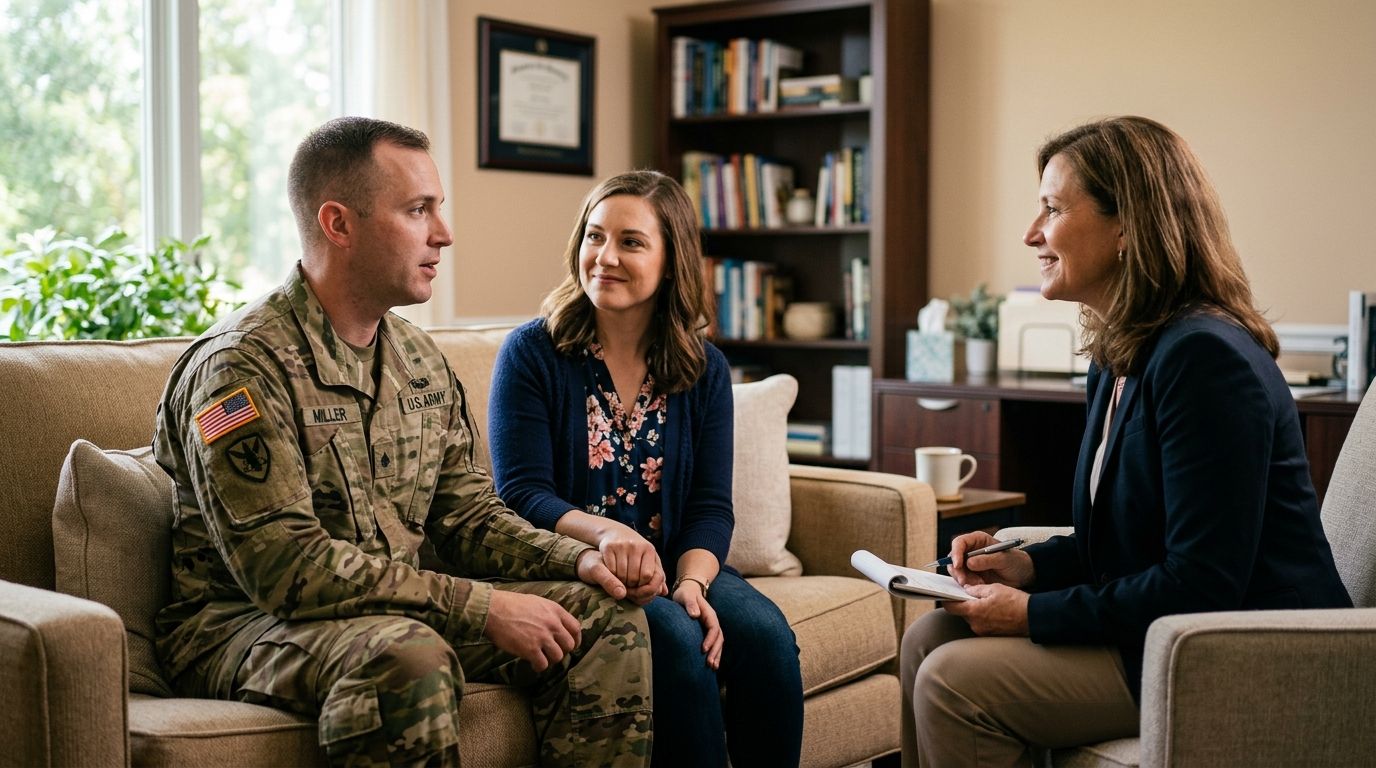
Couples counselling for military families is relationship support built around deployment cycles, training schedules, and postings instead of a fixed weekly appointment, with the goal of keeping communication and trust steady through separation and change. Service life puts pressure on a relationship most civilian couples never face — radio silence during a deployment, a partner who comes home different, a posting that uproots the household on a few months' notice. Counselling that assumes both partners live in the same city every week doesn't hold up against that reality.
- Couples counselling for military families works best when it’s scheduled around deployment cycles and leave, not a fixed weekly slot.
- Reintegration after time apart is its own adjustment period, distinct from the separation itself.
- Virtual sessions with Brandon Boorsma Counselling keep continuity going through postings and training exercises.
- Best for couples currently apart, recently reunited, or facing a posting move in the next 2026 rotation.
Why couples counselling matters for military families
Most couples counselling models assume consistency: same partner, same city, same week-to-week rhythm. Military life doesn't offer that. A partner might be gone for a training exercise one month and deployed for several the next, and the household that's left behind has to run without them.
The strain doesn't stop when the deployment ends. Coming back and slotting into old routines rarely goes smoothly — both people have changed, and the relationship they left isn't the one they're returning to. Couples who wait until conflict is already loud to get support usually have a harder time than couples who build in check-ins around partners who work away from home from the start.
Update your communication plan before the next separation
Don't wait for the next posting notice to figure out how you'll stay connected. Build the plan now, while you're both in the same room.
- Set a communication cadence you can actually keep — daily text, weekly call, whatever survives time zones and duty schedules
- Agree in advance on what counts as urgent versus what can wait for the next check-in
- Decide together how you'll handle missed calls or dropped connections without assuming the worst
- Write down the household decisions that need a joint call versus the ones the at-home partner can make solo
- Name one person (friend, family, base contact) each of you can lean on when the other is unreachable
Address the reintegration gap directly
Homecoming isn't a light switch. The partner who ran the household solo has new routines; the returning partner has to find a place in them.
- Talk through what actually changed in the household while they were gone, out loud, before assuming
- Rebuild shared decision-making slowly instead of handing everything back at once
- Expect a period of feeling like roommates before it feels like a marriage again
- Watch for irritability or withdrawal in either partner as a normal — not alarming — part of the adjustment
Use virtual counselling to bridge distance
When in-person sessions aren't realistic because of a posting, a training block, or a deployment, virtual couples counselling keeps the work going without waiting for both of you to be in the same place. Sessions run on video, so one partner can join from a different base, a training site, or overseas with a reliable connection, while the other joins from home in Lethbridge.
- Book sessions around leave blocks and training schedules instead of a fixed weekly time
- Use short check-in sessions during a deployment even if full couples work resumes after
- Keep the same counsellor through a posting move instead of starting over with someone new
- Bring specific incidents from the separation into session rather than trying to summarize months at once
Get individual support for service-related stress
Couples counselling handles the relationship, but service-related stress — hypervigilance, sleep disruption, difficulty switching off after a deployment — often needs its own space. Individual therapy for veterans and first responders addresses that side directly, and it can run alongside couples sessions rather than instead of them.
- Book an individual session if one partner is carrying symptoms the other can't fully see from the outside
- Keep individual and couples work with counsellors who communicate, or at minimum, keep each other briefed on the goals
- Don't treat individual therapy as a sign the relationship is failing — it's parallel support, not a substitute
Plan around leave, not around convenience
A counselling schedule that ignores training calendars and deployment windows falls apart within a few months. Build the plan around the actual calendar.
- Front-load sessions before a known separation instead of scheduling one and hoping for the best
- Book a reconnection session in the first few weeks after a return, before old patterns reassert themselves
- Treat a posting move as a trigger for a check-in, not just a logistics problem
- Revisit the plan every rotation — what worked last deployment may not work for the next one
“Reintegration after deployment is its own transition — the relationship you left isn’t the one you’re coming home to.”
Comparing your options as a military family
| Option | Best for | Format | Key limitation |
|---|---|---|---|
| Couples counselling with Brandon Boorsma Counselling | Couples wanting consistent clinical support through postings and deployment cycles | Video or in-person in Lethbridge | Requires a reliable connection during rotations abroad |
| Long-distance counselling built for separation | Couples currently apart during training or a posting | Video or phone | Less useful on its own once reintegration issues start |
| Base chaplain or padre support | Crisis or spiritual support during deployment | On-base, in person | Not specialized in structured couples work |
| Military Family Resource Centre programs | General family support and peer connection | Group workshops | Not one-on-one clinical counselling |
| Self-directed books or communication tools | Light maintenance between sessions | Reading or app-based | No professional guidance for higher-conflict situations |
The verdict: couples counselling for military families works best as clinical, one-on-one support that flexes around deployment and posting schedules — chaplain support and peer programs are useful additions, not replacements.
Book a session that fits your schedule
Sessions run virtual or in person in Lethbridge, built around leave and postings.
Common mistakes military families make
- Waiting until the week before deployment to start counselling — a single session before a long separation doesn't build the tools you'll need for months apart.
- Treating homecoming as a return to "normal" instead of a new adjustment period with its own conflicts.
- Cancelling sessions during training exercises instead of rescheduling around them — the gap in support tends to show up right when it's needed most.
- Letting one partner carry all the relocation logistics without ever processing the resentment that builds up — it surfaces eventually, usually at the worst time.
- Assuming a chaplain visit covers the couples work — pastoral support and structured couples counselling solve different problems.
FAQ
What is couples counselling for military families?
It’s relationship counselling structured around deployment cycles, training schedules, and postings rather than a fixed weekly appointment. Sessions can run virtual or in person and flex around leave blocks.
Can we do couples counselling if one partner is currently deployed?
Yes, virtual sessions allow one partner to join from a deployment location with a reliable connection while the other joins from home. Short check-in sessions can continue the work even when full sessions aren’t practical.
How does deployment affect a relationship long term?
Extended separation changes both partners’ routines and roles, and reintegration after the deployment ends is its own adjustment period. Couples who address this directly tend to rebuild trust faster than those who expect things to snap back to normal.
Is virtual couples counselling as effective as in-person for military couples?
Virtual sessions work well for maintaining continuity through postings and deployments when in-person visits aren’t realistic. The format matters less than keeping the same counsellor and a consistent cadence through the separation.
How soon after a posting move should we consider counselling?
Book a check-in within the first few weeks of settling into a new posting, before new stressors compound with the move itself. Waiting until problems are already loud makes the work harder.
Does couples counselling help with reintegration after deployment?
Yes, reintegration is one of the most common reasons military couples seek counselling, since the relationship rarely resumes exactly where it left off. A few sessions in the first month back can prevent small friction from becoming a larger conflict.
What’s the difference between a chaplain and a couples counsellor?
A chaplain or padre offers pastoral and spiritual support, often during a crisis or deployment. A Registered Psychologist provides structured, evidence-based couples work aimed at communication and conflict patterns specifically.
How much does couples counselling cost for military families in Alberta?
Fees vary by counsellor and session format, so check current rates directly with the practice you’re considering. Some employee and veteran benefit plans cover part of the cost — confirm coverage with your provider before booking.
One last thing
The couples who handle deployment and reintegration best in 2026 aren't the ones with the fewest separations — they're the ones who treat the return home as its own transition instead of a finish line. Book the reconnection session in the first few weeks back, before old patterns quietly reassert themselves.
Related guides
Leave a Reply