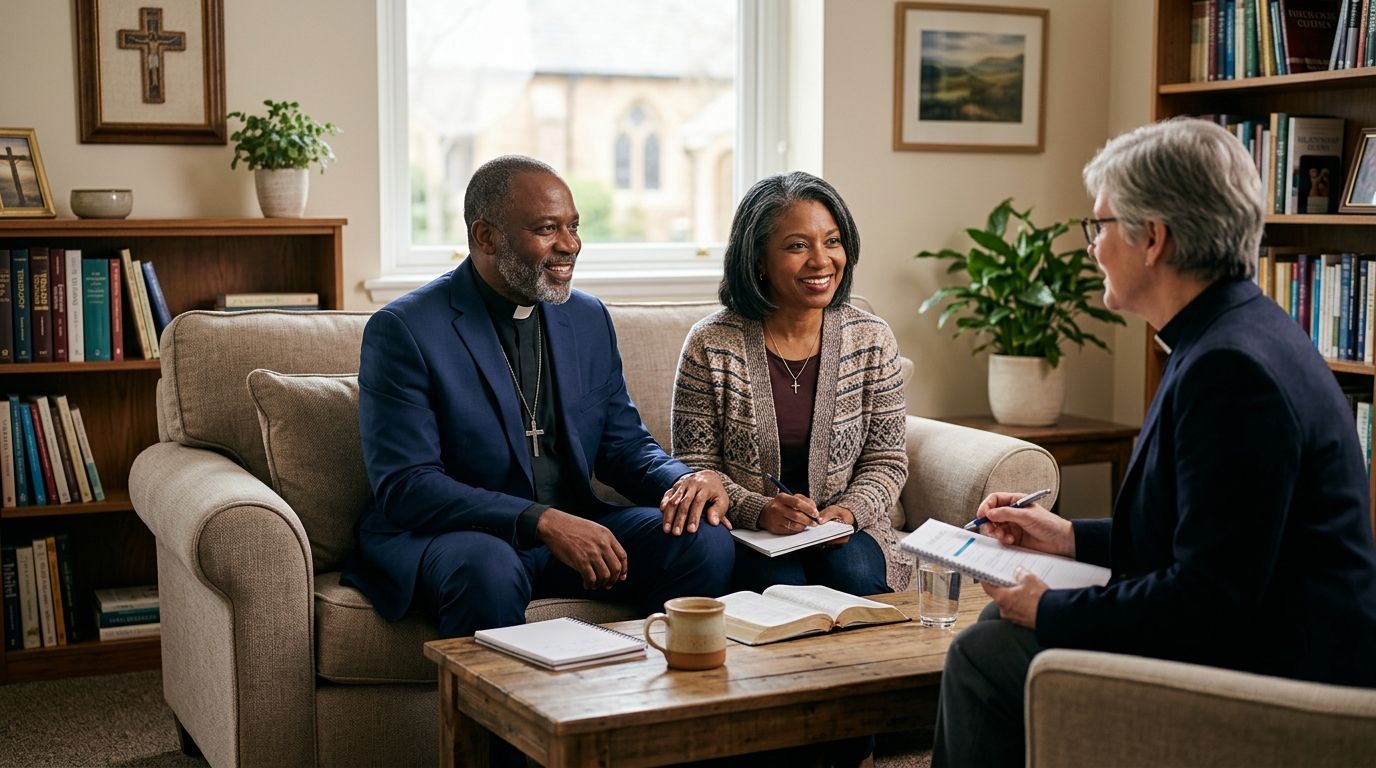
Premarital counselling for clergy couples is preparation built around one hard fact: pastors and their partners often guide other people's marriages before anyone helps them build their own. What makes this segment different from a standard engaged-couple session is confidentiality — a pastor cannot sit across from a counsellor who reports to the same board, presbytery, or denomination and expect an honest conversation about conflict, sex, money, or doubt.
- Premarital counselling for clergy couples works best with a counsellor outside the couple’s own denomination or congregation.
- Confidentiality, not theology, is the deciding factor in choosing who to see before the wedding.
- Ministry schedules (Sundays, funerals, hospital visits) need a written boundary before the wedding, not after.
- A Registered Psychologist in Lethbridge, Alberta can run this process without any reporting line to a church board.
- Follow-up sessions three to six months after the wedding matter as much as the premarital sessions themselves.
Why this matters
Clergy couples often delay getting help because seeking it themselves can feel like admitting failure in front of people who look to them for answers. Many denominations already require a form of premarital counselling for engaged couples before performing a wedding, but a mandated checklist session and real preparation are not the same thing.
A pastor who spends Sunday mornings advising other couples on their marriages needs a space, off the church calendar, to be the one asking questions instead of answering them. That distinction shapes everything else in this guide.
Why premarital counselling matters for clergy couples
Three pressures show up in this segment that rarely show up the same way for other engaged couples:
- The congregation watches. A rocky engagement or a public conflict becomes church conversation fast, which pushes many clergy couples to avoid outside help until problems are already set.
- Confidentiality is not optional. In a small congregation or a tight-knit denomination, a counsellor connected to that network creates a real risk that private material travels back to elders, deacons, or colleagues.
- The job does not turn off. Weddings, funerals, hospital visits, and Sunday services do not respect a couple's calendar, so premarital work has to plan around an unpredictable schedule instead of assuming a standard nine-to-five week.
“A pastor cannot do honest relationship work with a counsellor who reports back to the same board that ordained them.”
1. Name the dual role before the wedding
Most conflict in clergy marriages traces back to unspoken expectations about what "pastor's spouse" means day to day.
- Write down, separately, what each of you expects the role to look like week to week
- Compare lists and flag where they clash — attending every service versus protecting Sundays as family time
- Decide together which ministry obligations are shared duties and which stay with the ordained partner alone
- Set one written boundary now about interruptions during days off, before the wedding puts it under pressure
2. Choose a counsellor outside your own congregation network
This is the step where most clergy couples get stuck, because the easiest referral is often someone inside their own denominational structure.
- Rule out anyone who sits on, or reports to, the same board, presbytery, or governing body
- Ask directly how session notes are stored and who could ever request access to them
- Confirm the counsellor does not require doctrinal alignment to do relationship work
- A Registered Psychologist practicing outside church structures, such as Brandon Boorsma Counselling in Lethbridge, keeps the process separate from congregational politics while still respecting the couple's faith
3. Build a shared script for conflict, not just theology
Scripture-only conversations about conflict tend to skip the practical mechanics of how to actually disagree without escalating.
- Learn one concrete conflict structure — a Gottman-style repair attempt, a timeout signal, or a simple "I feel / I need" statement
- Practice naming the feeling before naming the fix
- Agree on a signal that pauses an argument before it plays out in front of a colleague or congregant
- Debrief disagreements within 24 hours instead of letting them sit through a full week of ministry obligations
- Review the topics covered in premarital counselling sessions so conflict skills get practiced alongside the standard agenda, not instead of it
4. Talk about money without treating it as taboo
Stipends, housing allowances, and manse arrangements complicate a conversation that is already uncomfortable for most engaged couples.
- Lay out both incomes side by side, including any housing allowance or in-kind compensation
- Decide who pays which bills and who tracks the budget month to month
- Discuss whether a spouse's outside income is expected, resented, or simply never mentioned
- Agree on a joint decision threshold for larger purchases before the wedding, not after the first disagreement about it
5. Protect time off from ministry demands
A schedule built entirely around the congregation's needs leaves nothing for the marriage unless a boundary gets built in deliberately.
- Block one full day per week with phones away from church email and pastoral calls
- Decide in advance how emergency pastoral calls override date nights, and how that lost time gets recovered afterward
- Keep vacation planning separate from denominational conferences or retreat schedules
- Revisit the boundary every few months, since ministry seasons like Advent, Easter, and camp season change the load
6. Address isolation and where real support comes from
Pastors counsel others for a living, which makes it easy to forget they need somewhere to be counselled themselves.
- Identify at least one person or couple outside the congregation each of you can be fully honest with
- Discuss whether either partner feels like the "example marriage" and how that pressure actually shows up day to day
- Decide together how much of the relationship stays private versus what gets shared from the pulpit or in a sermon illustration
- Build a maintenance rhythm rather than treating premarital counselling as a single box to check before 2026's wedding season
7. Set a follow-up plan after the wedding
Premarital counselling does not end the day the vows are said, especially when ministry routines swallow the first few months of marriage.
- Schedule a check-in three to six months after the wedding, once the ministry calendar settles back into a normal rhythm
- Revisit the boundaries set before the wedding and adjust them against what actually happened
- Stay with the same counsellor if the fit worked, since re-explaining ministry context to someone new costs time
- Treat the follow-up as maintenance, not crisis response
Comparing your options
| Option | Best for | Key limitation |
|---|---|---|
| Registered Psychologist outside the denomination (Brandon Boorsma Counselling) | Clergy couples who need confidentiality with no reporting line to a church board | Travel or virtual sessions needed if the couple lives outside Lethbridge |
| Denominational marriage-prep course | Couples comfortable working entirely within their own church structure | Confidentiality is limited when the facilitator answers to the same denomination |
| Retreat-style premarital weekend | Couples who want one intensive format alongside other engaged couples | Group format leaves little room for the specific pressures of ministry life |
| Self-directed workbook or online course | Couples on a tight schedule who want a starting point before formal sessions | No live feedback on the conflict patterns that only show up in real conversation |
Verdict: premarital counselling for clergy couples works best with a Registered Psychologist who has no reporting relationship to the couple's own denomination — that's what Brandon Boorsma Counselling in Lethbridge, Alberta is built to offer.
Talk to someone outside your congregation
Confidential premarital sessions with a Registered Psychologist in Lethbridge.
Common mistakes clergy couples make
- Treating it as a checkbox. Rushing through the minimum number of sessions a denomination requires instead of using the time for real preparation.
- Choosing a counsellor inside the same denomination. The referral is convenient, but it creates a confidentiality risk the couple usually doesn't notice until it's too late.
- Assuming pastoral training equals relationship skill. Being trained to counsel other couples does not mean the same tools apply automatically to your own marriage.
- Letting the wedding date set the pace. Compressing the process to fit a booked venue instead of the couple's actual readiness.
- Ignoring the always-on-call schedule until after the wedding. Resentment about interrupted evenings and cancelled anniversaries builds fast once the honeymoon phase ends.
FAQ
Is premarital counselling different for pastors and clergy couples?
Yes — the biggest difference is confidentiality, since a counsellor connected to the couple’s own denomination creates a reporting risk that other engaged couples don’t face. The content overlaps with standard premarital work, but the choice of counsellor matters more.
Should a pastor see a counsellor inside their own denomination?
Generally no, because a counsellor who sits on or reports to the same board can compromise honest disclosure. An independent Registered Psychologist outside the church structure removes that conflict.
How many sessions does premarital counselling for clergy couples usually take?
The number varies by couple and gets set during the first session based on what needs the most attention. A follow-up session three to six months after the wedding is worth planning for regardless of how many sessions came before it.
Can premarital counselling be done virtually for clergy couples in rural congregations?
Virtual sessions work well for couples serving rural or remote congregations who can’t easily travel for in-person appointments. The confidentiality and format considerations stay the same either way.
What topics come up most in premarital counselling for clergy couples?
Boundaries around ministry time, confidentiality and isolation, and finances tied to stipends or housing allowances come up more often here than in standard premarital sessions. Standard topics like communication and conflict resolution still apply on top of those.
Does premarital counselling help with the isolation pastors feel?
It can, by giving both partners a space to name the pressure of being the ‘example marriage’ out loud. That naming is often the first step toward building support outside the congregation.
Is premarital counselling covered by insurance for clergy couples in Alberta?
Coverage depends on the couple’s individual extended health plan, so check current benefits before booking. Ask directly when scheduling since coverage details vary by provider and plan.
What’s the best time to start premarital counselling before a wedding?
Starting several months before the wedding gives enough room to address ministry-specific issues without rushing. Waiting until weeks before the date usually turns real preparation into a formality.
One last thing
The clearest sign a clergy couple has found the right counsellor: the pastor stops slipping into sermon-mode mid-session and starts answering as a spouse, not as a spiritual leader. That shift, more than any single topic covered, is what separates a checkbox exercise from actual preparation going into 2026 and beyond.
Related guides
- How to choose the right premarital counselling program
- Premarital counselling cost in Alberta
- Best questions to ask a premarital counsellor before booking
Leave a Reply