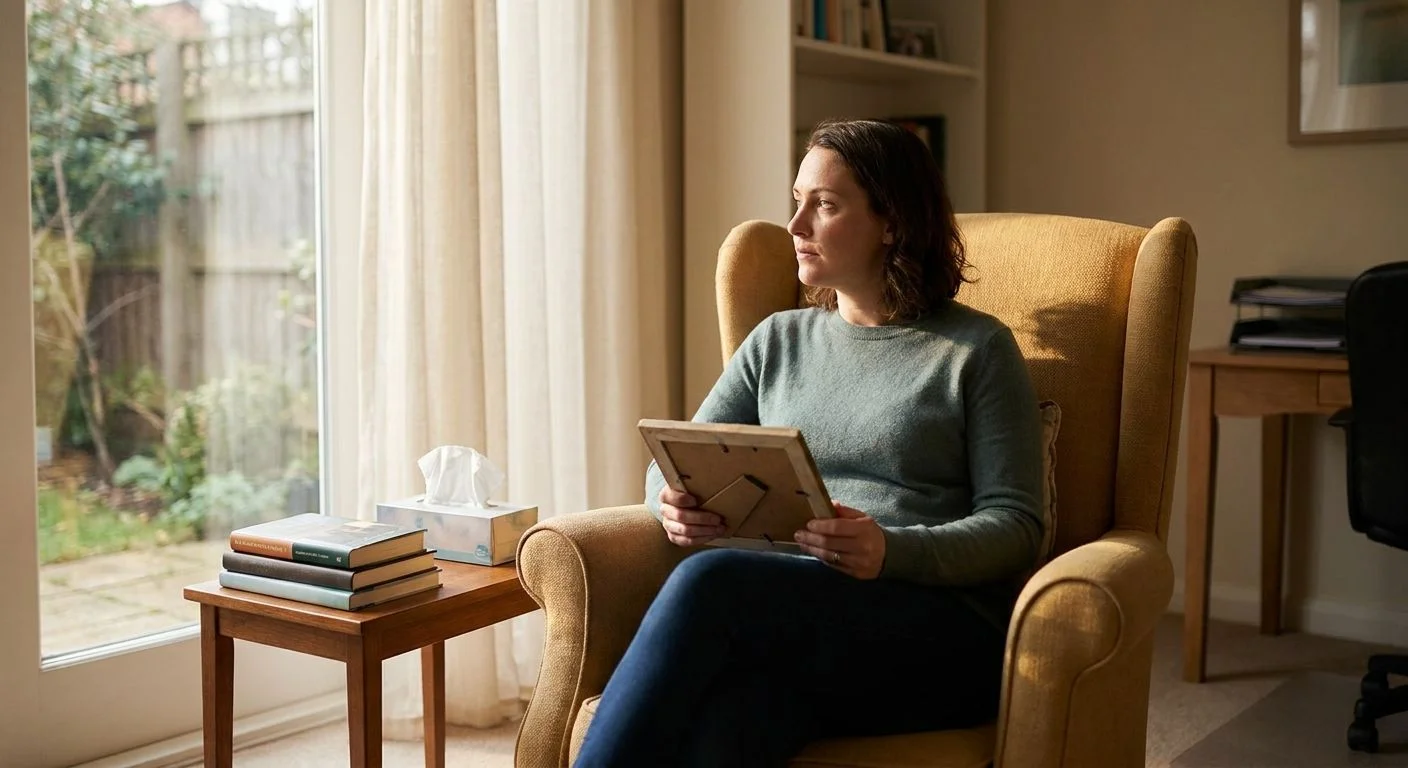
Growing up in a divided household leaves marks that don't show up until your late 20s or 30s — in how you trust, how you fight, and how fast you bail when things get hard. Individual therapy for adult children of divorce in Lethbridge, Alberta gives you a place to trace those patterns back to their source and change how you show up in your own relationships.
- Therapy for adult children of divorce works best when it targets family-of-origin patterns, not just anxiety symptoms.
- Individual therapy for family estrangement fits if divorce cut off contact with a parent — start here.
- Individual therapy for major life transitions suits engagement, marriage, or new parenthood triggering old fears.
- A single grief-focused session rarely resolves decades-old patterns — plan on ongoing work, not a quick fix.
- Brandon Boorsma Counselling in Lethbridge offers individual sessions built around CBT and attachment-informed approaches.
Why this matters
Divorce doesn't stay in childhood. Adults whose parents split — whether it happened when you were 6 or 26 — often carry specific patterns into their own relationships: hypervigilance around conflict, trouble trusting a partner who says they're staying, or a habit of ending things before someone else can end it first. Brandon Boorsma Counselling works with adults in Lethbridge who are ready to name those patterns and change how they respond, using CBT and attachment-informed methods rather than generic talk therapy.
These patterns rarely resolve on their own by your 30s or 40s. They tend to surface hardest right before a wedding, after a breakup, or when your own kids reach the age you were when your parents split — which is exactly why so many people start this work in 2026 after years of managing it alone.
Who this is for
This is for adults, 20s through 60s, whose parents divorced or separated, and who notice the aftershocks showing up now: guilt about picking sides, anxiety before committing to a partner, or a pattern of walking away from relationships the moment they get serious. It's also for people who thought they'd made peace with their parents' divorce years ago, until a wedding, a pregnancy, or a parent's remarriage reopened it. If you're the one everyone calls stable but you're privately terrified of repeating your parents' marriage, this is written for you.
What to look for in therapy for adult children of divorce
It targets the family-of-origin pattern, not just the symptom
Anxiety, trust issues, or a fear of commitment showing up now usually trace back to something specific that happened decades ago. Good therapy asks directly what you watched growing up, not just how to manage today's symptom in isolation.
It gives you room to grieve a divorce that happened decades ago
People feel embarrassed grieving something that happened 20 or 30 years ago, as if there's a statute of limitations on it. There isn't — unprocessed grief from childhood doesn't age out just because you're an adult now.
It uses a structured method, not just venting
CBT and attachment-informed frameworks give you tools to interrupt a pattern in real time, not just a weekly hour of talking about your parents. Structure matters because insight alone rarely changes behaviour under stress.
It connects to your current relationship, not just your past
The work matters because it changes how you handle conflict, intimacy, or trust today. A therapist who only stays in 1998 with you isn't doing the second half of the job.
It has a clear next step if couples work comes up
Sometimes patterns from your parents' divorce surface as conflict inside your own relationship. A good therapist has a pathway to bring a partner in later without treating it as a separate, unrelated process.
“Naming the exact pattern you picked up from watching your parents moves the work faster than describing vague trust issues ever will.”
Where to start
The estrangement angle: if divorce cut off a parent completely
This is the one to start with if a parent is still physically alive but effectively out of the picture. If your parents' divorce meant one parent moved away, remarried and started over, or simply stopped showing up, the grief is different from garden-variety family conflict. Individual therapy for family estrangement addresses the specific ache of a parent who is absent but not gone. Start here if a missing parent is still shaping how much you let anyone else get close.
The pattern-anxiety angle: when it shows up as anxiety now
This is the one to start with if your body reacts before your brain does. Some adult children of divorce don't consciously think about their parents' split, but their nervous system spikes when a partner is 10 minutes late or goes quiet mid-argument. Individual therapy for anxiety in Lethbridge fits when the presenting problem looks like anxiety but the root is old hypervigilance from a high-conflict household. Consider this route if panic or catastrophizing shows up specifically around relationship uncertainty.
The self-worth angle: when you assume you're the problem
This is the quieter symptom to watch for: chronic self-doubt. Kids of divorce sometimes absorb the idea that they weren't reason enough for a parent to stay, and that belief calcifies into low adult self-esteem. Individual therapy for low self-esteem is the right entry point if you over-apologize, over-function to earn love, or assume every relationship problem is your fault before hearing the other side. Consider this route if the anxiety framing doesn't quite fit but self-worth clearly does.
The transition angle: when a life event reopens it
This explains why it's surfacing now, not at 22. A lot of adult children of divorce feel fine for years, then a wedding, a first pregnancy, or a parent's remarriage cracks it back open. Individual therapy for major life transitions is built for that exact moment, when an old wound resurfaces because of something happening today rather than anything getting worse on its own. Watch for this if your reaction to a happy event feels bigger, or darker, than it should.
Talk to Brandon about what fits
A first session helps identify which pattern you’re actually working with.
What to avoid
- A single "closure" session that treats this like old news. Two or three decades of pattern-building doesn't unwind in one appointment; a provider promising a quick fix is a mismatch.
- Therapy that centers your parents' divorce story instead of your current relationships. The point isn't to relitigate what happened years ago, it's to change how you argue with your partner in 2026.
- Couples counselling as a substitute for your own individual work. If a partner is pushing you to "just talk to someone," bringing them into a session before you've done your own work can turn therapy into another argument instead of a resource.
Verdict comparison
| Pathway | Best for | Core focus | Verdict |
|---|---|---|---|
| Family estrangement work | A parent is still absent or estranged | Grieving a living parent | Start here |
| Anxiety-focused work | Nervous system reacts before you think | Hypervigilance, panic | Consider |
| Low self-esteem work | Chronic self-blame, over-functioning | Self-worth rebuilding | Consider |
| Major life transitions work | Old wound reopened by a wedding, baby, etc. | Present-day trigger | Watch for this |
FAQ
What is therapy for adult children of divorce?
Therapy for adult children of divorce is individual work focused on how a parents’ separation shaped your patterns around trust, conflict, and commitment as an adult. It goes past general anxiety or relationship counselling by tracing current behaviour back to what you watched growing up.
Is it normal to still be affected by my parents’ divorce as an adult?
Yes, it’s common for the effects of a childhood divorce to surface decades later, often triggered by your own engagement, marriage, or first child. The delay doesn’t mean the impact wasn’t real; it means the trigger simply hadn’t happened yet.
How is this different from regular individual therapy?
Regular individual therapy can address anxiety or low mood generally, while this approach specifically traces those symptoms back to family-of-origin patterns from the divorce. The framing changes the questions asked and the pace of the work.
Does it matter how long ago my parents divorced?
No, it doesn’t matter whether it happened 5 years ago or 30 years ago. Unprocessed grief and unlearned patterns don’t have an expiry date, and adults working through a decades-old divorce is common in 2026.
Can this help if I’m not in a relationship right now?
Yes, being single is often a good time to do this work, since there’s no active relationship dynamic to untangle at the same time. Many people use single stretches to understand their patterns before dating again.
Should I bring my partner into a session too?
Not at the start. Individual work first gives you clarity on your own patterns, and couples sessions can follow later if the work naturally points that direction.
How much does individual therapy cost in Lethbridge?
Rates vary by provider and session length, so check current pricing directly with the practice you’re considering. Some benefits plans in Alberta cover psychologist sessions, which is worth confirming before booking.
How do I know if it’s working?
You’ll notice it working when you can name the specific pattern out loud, tied to a real memory, instead of describing vague trust issues. That specificity is usually the point where behaviour starts shifting in current relationships.
One last thing
The strongest predictor of how someone does in this work isn't whether their parents divorced, it's whether they can say a sentence like "I do this because I watched my parent do that" out loud, with a real memory attached. People who get specific tend to move faster than people who stay at "I just have trust issues." That precision, not just acknowledging the divorce happened, is what actually shifts things in 2026 sessions and beyond.
Related guides