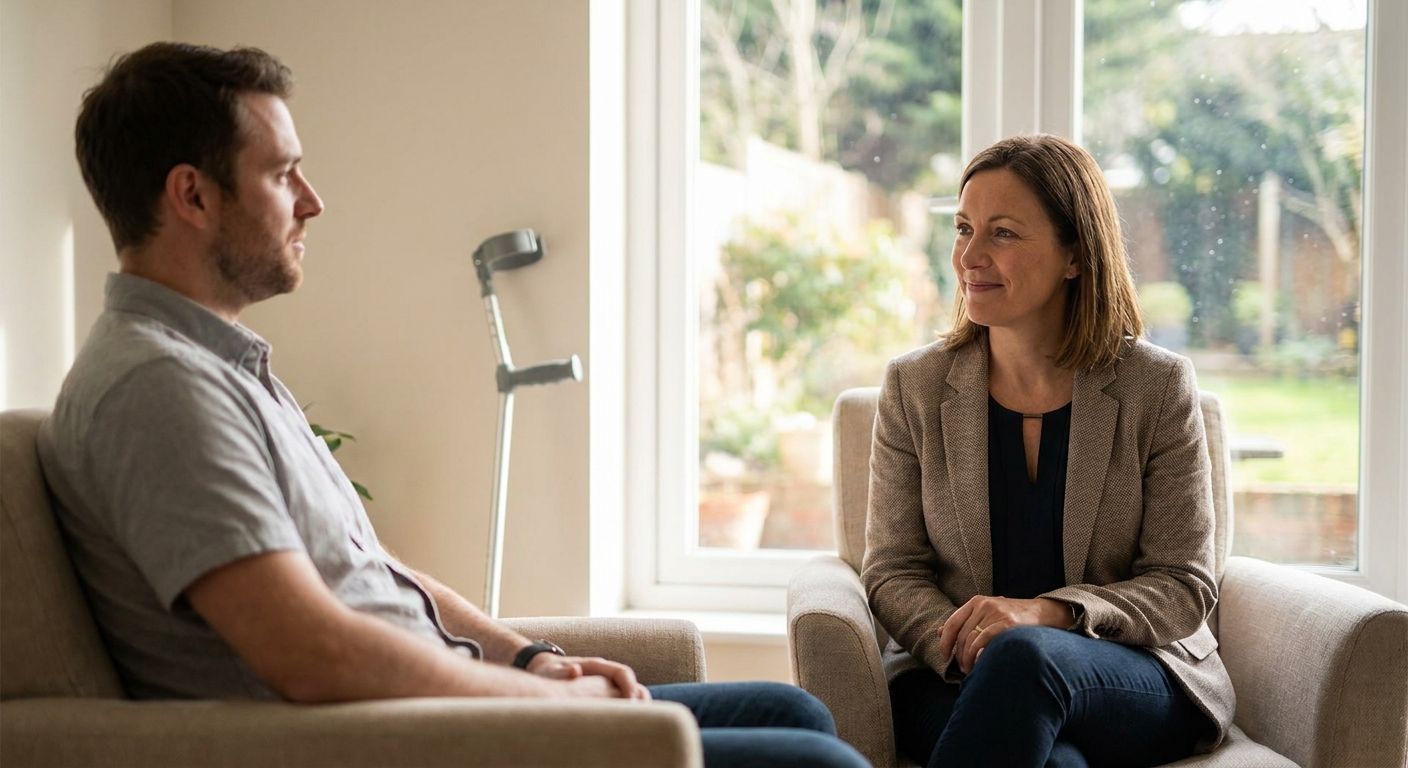
If a car accident, workplace injury, or bad fall left you jumpy, avoidant, or stuck replaying the moment months later, therapy for trauma after an accident gives you a structured way out of that loop rather than waiting for time alone to fix it.
- Trauma-focused CBT is the standard starting point for therapy for trauma after an accident, often run over 8 to 15 sessions.
- Individual therapy for major life transitions fits well when the injury changed your job, mobility, or daily routine, not just your nerves.
- Symptoms lasting more than one month after the event meet the general threshold clinicians use to flag PTSD, not just normal shock.
- General life coaching or one-size-fits-all group programs are the wrong fit if the accident left lasting flashbacks or avoidance.
- Brandon Boorsma Counselling in Lethbridge treats accident and injury trauma as a specific clinical presentation, not generic stress.
Why this matters
An accident doesn't stay in the past just because the bruises heal. If you're searching for therapy for trauma after an accident in 2026, you're likely dealing with something more specific than "stress": intrusive memories, a spike in anxiety near cars or machinery, or a body that won't relax even when nothing is wrong.
Untreated, this pattern tends to calcify rather than fade. The gap between "I'm fine, just shaken up" and a diagnosable trauma response is often measured in weeks, not months, and the sooner you name it, the shorter the road back tends to be.
Who individual trauma therapy is for
This is for anyone who walked away from a car crash, a workplace injury, a fall, or a medical emergency and hasn't walked away from it emotionally. You might be sleeping fine physically but bracing every time you get behind the wheel, or you're back at work but flinching at sounds that echo the incident.
It's also for people whose injury reshaped their life beyond the trauma itself: a job change, a mobility limit, a identity shift from "active" to "recovering." Individual therapy for major life transitions overlaps heavily here when the accident forced changes you didn't choose.
If your symptoms are mild and fading on their own, you may not need this yet. If they've lasted more than a month, that's the general clinical threshold where a trauma response, not ordinary shock, becomes the more accurate read.
What to look for in therapy for trauma after an accident
Trauma-informed training, not general counselling
A counsellor with broad experience in anxiety or relationships isn't automatically trained to work with trauma responses. Ask directly what modality they use for post-accident trauma and whether they've treated it before, not just adjacent issues.
A clear plan for the first few sessions
Good trauma work doesn't start by asking you to relive the worst moment in detail. Early sessions should focus on stabilizing your nervous system and building safety before any processing work begins.
Room for the physical piece
Accidents and injuries often carry both physical recovery and psychological recovery at once. A therapist who ignores your pain, mobility restrictions, or ongoing medical appointments is missing half the picture.
Flexibility around claims and scheduling
WCB claims, insurance processes, or legal proceedings tied to the accident can shape when and how often you can attend sessions. In 2026, more insurers and case managers are pre-approving trauma-focused counselling early, which changes how quickly you can start.
Willingness to name avoidance and hypervigilance directly
If a therapist talks around "stress" but never names avoidance, flashbacks, or startle responses by their clinical terms, they may not be tracking the actual trauma pattern.
A way to measure progress
You should be able to tell, session by session, whether you're driving past the intersection again, sleeping through the night, or still flinching at the same triggers. Vague reassurance isn't progress tracking.
Paths worth considering
Trauma-focused CBT — the structured path. This remains the standard approach heading into 2026 for accident-related trauma, typically run in 50-minute sessions across an 8 to 15 session arc depending on severity. It works by directly targeting the thoughts and avoidance patterns keeping the trauma response alive, rather than just processing feelings in the abstract. If you want a defined start and end point, start here.
Support for chronic pain layered with trauma. Some accidents leave lasting physical injury alongside the psychological hit, and treating one without the other stalls progress on both. Individual therapy for chronic pain and ongoing illness is built for exactly that overlap. Worth adding if pain management and trauma symptoms are tangled together.
Support when the accident became a bigger life shift. If the injury changed your job, your independence, or how you see yourself, the trauma work alone won't cover it — you also need help rebuilding the life around it. That's the territory individual therapy for major life transitions handles, already referenced above. Consider it if the accident's aftershocks reach further than the memory itself.
What to avoid
- General life coaching marketed as trauma recovery. Coaching can help with motivation, but it isn't a substitute for a licensed clinician trained in trauma-specific treatment.
- Providers who push you to relive details in session one. Diving into the worst moment before any stabilization work is a common mistake, and it can make symptoms worse, not better.
- One-size-fits-all group programs when you need one-on-one work. Group formats can help later in recovery, but early trauma work usually needs individual attention to your specific triggers and timeline.
Verdict comparison
| Path | Best for | Typical structure | Verdict |
|---|---|---|---|
| Trauma-focused CBT | Recent accident, flashbacks, avoidance | 50-minute sessions, 8-15 session arc | Start here |
| Chronic pain + trauma support | Lingering physical injury with anxiety | Paced to physical recovery timeline | Worth adding |
| Life-transition focused work | Accident forced a job, identity, or mobility change | Open-ended, revisited as life shifts | Consider if it fits |
FAQ
What is therapy for trauma after an accident?
It’s individual counselling focused on processing intrusive memories, avoidance, and heightened anxiety that follow a car accident, workplace injury, or fall. Trauma-focused CBT is the most common structured approach used for this in 2026.
How soon after an accident should I start therapy?
You can start as soon as symptoms interfere with daily life, even in the first weeks. Waiting past the one-month mark, when clinicians start considering a PTSD diagnosis rather than normal shock, usually means a longer road back.
Is CBT or EMDR better for accident-related trauma?
Both are established approaches for post-accident trauma, and the right fit depends on how you respond to talk-based processing versus eye-movement-based reprocessing. A trauma-informed therapist should discuss both with you before choosing.
How many sessions does trauma therapy usually take?
Trauma-focused CBT protocols commonly run 8 to 15 sessions, though this varies with how long symptoms have been present and how severe the injury was. Ongoing physical recovery can extend the timeline.
Can therapy help with pain, not just anxiety, after an injury?
Therapy won’t replace medical treatment for physical injury, but it can reduce the anxiety and muscle tension that make chronic pain feel worse. Addressing both together tends to produce faster relief than treating either alone.
What’s the difference between normal stress and PTSD after an accident?
Normal stress after an accident usually fades within a few weeks as the nervous system settles. Symptoms that persist past one month, including flashbacks, avoidance, and hypervigilance, meet the general threshold clinicians use for a PTSD diagnosis.
Can trauma therapy be done virtually?
Virtual counselling has become common across Canada, and many therapists offer it alongside in-person sessions. Confirm directly with your provider whether virtual individual sessions are available before booking.
Does insurance or WCB cover therapy for accident trauma?
Coverage depends on your specific policy or claim type, and more insurers and WCB case managers have been approving trauma-focused counselling earlier in the claims process through 2026. Check with your provider or case manager directly for your situation.
One last thing
The detail people miss most: trauma symptoms don't always show up as fear. Irritability, numbness, or just feeling "flat" since the accident are just as common a presentation as flashbacks, and they're the ones people wait longest to bring to a therapist because they don't look like textbook trauma.
Related guides
Leave a Reply