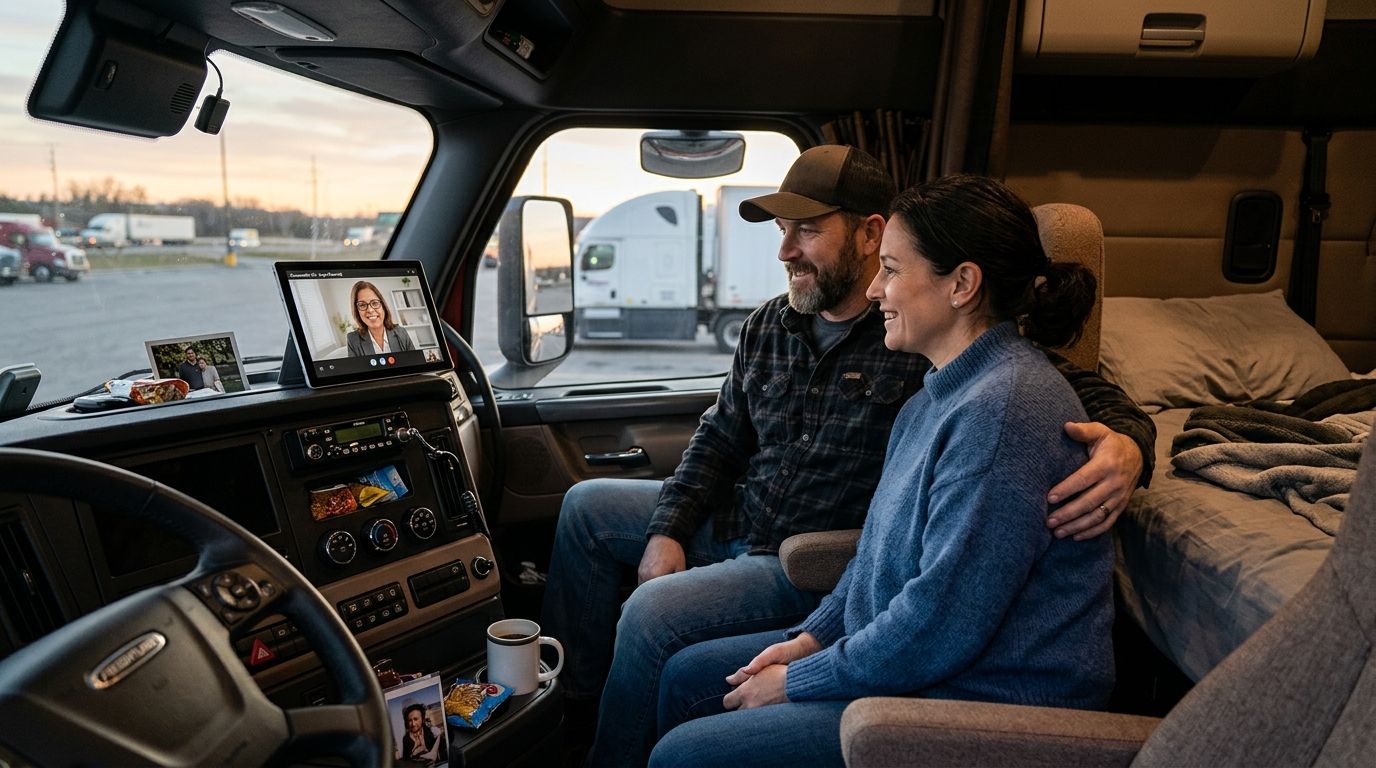
Couples counselling for long-haul truck drivers is structured relationship support built around multi-day absences, irregular dispatch schedules, and the specific strain of running a household split between the cab and the kitchen table. Standard weekly-session marriage counselling assumes both partners are home on the same night every week — trucking couples rarely get that, so the approach has to bend around rotation, not the other way around.
- Couples counselling for truck drivers works best delivered by video, scheduled around dispatch instead of a fixed weekly slot.
- Brandon Boorsma Counselling, a Registered Psychologist in Lethbridge, works with couples on mismatched and irregular schedules.
- Reunion-week conflict is a scheduling pattern, not a personality clash — plan for it before it happens.
- Waiting until a driver’s home stretch to raise a problem lets small issues compound over the trip.
Why couples counselling matters for truck drivers
A long-haul driver in Canada can legally be on the road up to 13 hours of driving within a 14-hour work window, and up to 70 hours across a 7-day cycle under the National Safety Code hours-of-service rules. That's not a minor scheduling quirk — it means the at-home partner is running the household, the kids, and the decisions solo for stretches that a typical couple never has to plan around.
The strain isn't usually about the driving itself. It's about what happens to communication when two people go from constant micro-contact to three days of texting logistics and then a sudden 48 hours of forced closeness. Couples counselling for partners who work away from home covers the broader pattern; trucking adds the extra layer of unpredictable routes, weather delays, and a schedule that can shift mid-week.
The verdict: couples counselling for truck drivers succeeds when it's built around the rotation, not fitted awkwardly into a format designed for two people who see each other every night.
Map your actual time-apart pattern
Before any counselling conversation, get specific about the real schedule instead of talking in vague terms like "he's gone a lot."
- Write down the actual days on and days home for the last 4-6 weeks, not the theoretical schedule
- Note which weeks had unplanned extensions (weather, freight delays, breakdowns)
- Flag the two or three moments each trip where friction tends to spike (departure day, mid-trip check-ins, first night home)
- Compare notes with your partner — most couples are surprised by how differently each of them remembers the same week
Build a communication routine that survives spotty signal
Most trucking-couple conflict starts with mismatched expectations about contact, not lack of love.
- Agree on one predictable check-in time per day, even if it's just a text saying "stopped for the night"
- Separate logistics texts (kids, bills, appointments) from relationship texts so neither gets buried
- Decide in advance what counts as "radio silence is fine" versus "something's wrong" — dead zones and mandatory rest breaks aren't the same as avoidance
- Skip the guilt-trip texts about being unreachable; they train the driving partner to dread checking in
Use virtual sessions to close the distance gap
This is where a video-based counselling format changes the math for a driving couple. Waiting for both partners to be home, awake, and available on the same evening for a 50-minute session is close to impossible on a rotating trucking schedule.
Virtual couples counselling for busy schedules lets one partner join from a truck stop parking lot and the other from the living room, at a time that actually fits the week instead of forcing the relationship to work around a therapist's Tuesday-at-6pm slot. It's not a downgrade from in-person work — it's the format that matches how the relationship already runs.
- Confirm ahead of time that the cab or stop has a stable enough connection for video, not just audio
- Pick a recurring day-of-week anchor (e.g., "the Thursday before he's home") rather than a fixed clock time
- Use the drive-time between stops for a private moment if the household is loud during the actual session window
- Treat a missed session from a delayed run as a scheduling issue to solve, not a sign the process isn't working
Plan the reunion, not just the departure
Most couples prepare emotionally for goodbye and completely skip preparing for hello. That's backwards — reunion week is where a lot of trucking-couple conflict actually surfaces.
- Name out loud that the first 24-48 hours home involve a re-adjustment, not an instant return to normal
- Agree on one "decompress" window before diving into household catch-up (a coffee, a walk, twenty minutes of nothing)
- Hand off parenting and household control gradually instead of all at once on day one
- Save the heavier conversations (finances, in-laws, big decisions) for day two or three, not the driveway
Separate solo decisions from joint decisions
One partner making every day-to-day call while the other is on the road creates a slow drift toward two separate operating systems for the same household.
- List which decisions the at-home partner can make solo without a check-in (groceries, school forms, small repairs)
- List which decisions genuinely wait for both people (major purchases, moving, changing a kid's school)
- Revisit that list every few months — what worked when the kids were younger may not work now
- Don't let "I didn't want to bother you on the road" become the default reason big decisions get made alone
Watch for mismatched-schedule strain specifically
Trucking relationships share a lot with other mismatched-schedule couples, but the routes and hours-of-service rules add unpredictability that shift work in a fixed plant or hospital doesn't have. Couples counselling for mismatched shift-work schedules addresses the general pattern of two people running on different clocks.
- Track whether resentment is building around who "gets" more rest
- Check whether intimacy has quietly become tied only to the first night home
- Notice if the at-home partner has stopped mentioning problems because "there's nothing he can do about it from the road anyway"
- Ask whether either partner has started treating the other's schedule as a convenient excuse to avoid a hard conversation
Comparison: options for trucking couples in 2026
| Option | Best for | Key limitation |
|---|---|---|
| Virtual couples counselling | Couples with rotating or unpredictable routes | Needs a stable connection and some privacy at the driver's end |
| In-person couples counselling | Couples with predictable, shorter local routes | Hard to schedule around dispatch changes and weather delays |
| Self-guided books or apps | Couples wanting a starting point between sessions | No feedback loop — works alongside counselling, not instead of it |
| Waiting until home time | Couples who genuinely have minor, occasional friction | Lets bigger issues compound over multi-day trips |
The straightforward read: virtual couples counselling is the format built for how trucking schedules actually work in 2026 — everything else asks the relationship to bend around a rigid appointment instead.
Common mistakes trucking couples make
- Saving every problem for "when I get home." By the time the driver is back, three separate issues have merged into one exhausting conversation nobody wants to have.
- Treating the at-home partner's routine as automatically easier. Solo parenting and solo decision-making for days at a stretch is its own load, and dismissing it breeds resentment fast.
- Scheduling counselling around dispatch instead of committing to a recurring slot. A session that only happens "if the route allows it" rarely gets the consistency that actually shifts a pattern.
- Skipping the reunion conversation entirely. Jumping straight from goodbye-mode to normal-life-mode without acknowledging the transition sets up avoidable first-night-home fights.
- Assuming the honeymoon-feeling first night proves everything's fine. A good reunion night says more about relief than it does about whether the underlying issue got addressed.
Book a session that fits your route
Virtual couples counselling scheduled around your rotation, not a fixed weeknight slot.
FAQ
What’s the best type of couples counselling for truck drivers?
Virtual couples counselling is generally the best fit for truck drivers because it doesn’t require both partners to be home and awake at the same fixed time each week. It lets one partner join from a truck stop and the other from home, on a schedule built around the route instead of a clinic’s calendar.
Can truck drivers do couples counselling virtually while on the road?
Yes, as long as there’s a stable enough connection for video and a few minutes of relative privacy. Many drivers join from the cab during a rest break or from a truck stop with reliable wifi.
How often should couples counselling happen when one partner is on rotation?
A recurring day-of-week anchor tied to the route (like the day before a driver gets home) tends to work better than a fixed clock time. Consistency matters more than frequency — a predictable every-other-week session beats an irregular weekly one that keeps getting cancelled.
Is couples counselling for truck drivers different from regular marriage counselling?
The core approach to communication and conflict is the same, but the scheduling and the specific pattern of reunion-week friction are unique to driving couples. A counsellor who understands hours-of-service unpredictability will plan sessions differently than one working with a couple who sees each other every night.
What if my partner refuses to do a video session from the truck?
Start with a conversation about what specifically makes it uncomfortable — privacy, connection quality, or just unfamiliarity with the format. Many drivers who are hesitant at first find that a short first session, even just to meet the counsellor, lowers the resistance.
Can individual therapy help alongside couples counselling for a truck driver?
Yes, especially when isolation or the mental load of long stretches away is hitting one partner harder than the other. Individual sessions can run in parallel with couples work without duplicating it.
How long does it take to see results in couples counselling for driving couples?
It depends on the couple, but most notice a shift in how reunion week goes within the first several sessions once a communication routine and a reunion plan are in place. Progress tends to show up first in reduced first-night-home conflict, before deeper issues are fully resolved.
Does couples counselling work if sessions get rescheduled often because of route changes?
It can, as long as both partners stay committed to rebooking rather than letting cancellations quietly become a pattern of avoidance. A counsellor used to shift and rotation schedules will expect some rescheduling and plan around it.
One last thing
The hardest part of couples counselling for truck drivers usually isn't the driving schedule — it's the first-night-home conversation nobody planned for. Couples who name that transition explicitly, even with one sentence like "let's not solve anything heavy for the first hour," report far less friction than couples who expect the relationship to just snap back to normal the second the truck pulls into the driveway. That one small agreement does more work in 2026 than most couples expect.
Related guides
- Individual therapy for shift workers with irregular schedules
- How to reconnect with your partner after a busy season of life
Leave a Reply