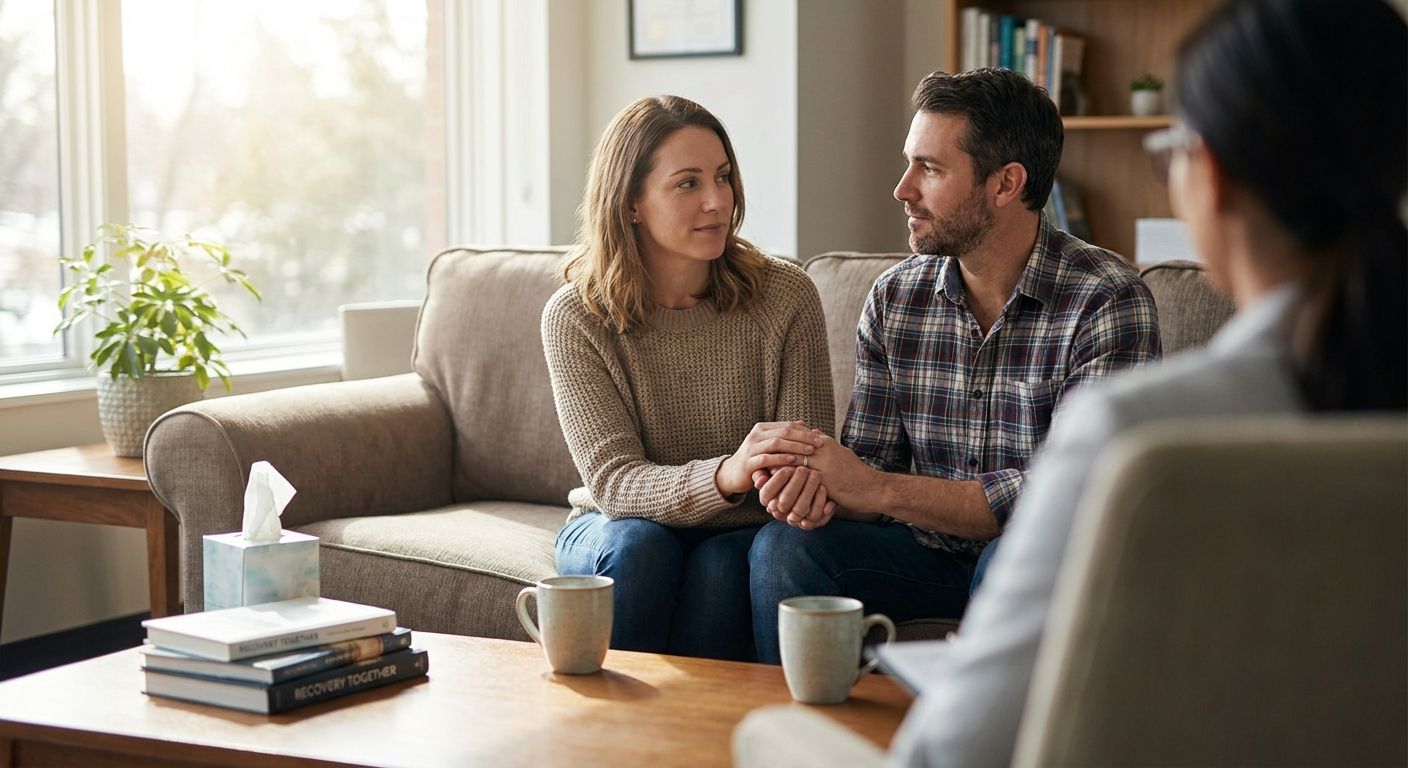
Addiction rarely stays contained to one person. It shows up in broken trust, canceled plans, financial secrets, and a partner who has learned to brace for the next disappointment. Couples counselling for addiction recovery gives both people a structured way to rebuild the relationship while the person using substances works on their own recovery, whether that's early sobriety or years into maintaining it.
- Couples counselling for addiction recovery works best alongside individual addiction treatment, not instead of it.
- Behavioral Couples Therapy research links partner involvement to lower relapse rates than individual treatment alone.
- Brandon Boorsma Counselling in Lethbridge pairs relationship-conflict work with individual therapy tracks for the non-using partner.
- Trust and infidelity recovery counselling is the safe first pick when secrecy around use has damaged the relationship.
- Skip couples-only sessions if active, untreated addiction is still in crisis mode in 2026 — individual treatment comes first.
Why This Matters
Most couples wait far too long to bring a relationship into the recovery conversation. By the time they book a session, the non-using partner has usually been managing the fallout alone for months, sometimes years — and resentment has calcified into something harder to untangle than the addiction itself.
Relationships affected by addiction tend to develop the same patterns: one partner over-functions, the other withdraws or minimizes, and every disagreement about money, parenting, or trust gets routed back through the addiction. Couples counselling for relationship conflict exists to interrupt that cycle before it becomes the entire relationship.
Research on Behavioral Couples Therapy, going back to work by O'Farrell and Fals-Stewart, consistently links partner involvement in recovery to fewer relapses and higher relationship satisfaction than individual treatment alone. That doesn't mean couples work replaces addiction treatment — it means the relationship gets stronger footing while the addiction gets treated on its own track.
Who This Is For
This guide is for couples in Lethbridge and southern Alberta where one or both partners are dealing with substance use, gambling, or another compulsive behavior that's straining the relationship. It applies whether the person is newly sober, relapsed after time away from use, or has never formally sought addiction treatment but the impact on the relationship is already obvious. It's not a substitute for detox, medical treatment, or crisis intervention — it's the relationship layer that sits alongside those things.
What to Look for in Couples Counselling for Addiction Recovery
A therapist who separates addiction treatment from relationship treatment
The two need different containers. A Registered Psychologist working on the relationship isn't there to manage withdrawal or run a treatment protocol — they're there to help both partners rebuild communication and trust while addiction treatment happens elsewhere. If a counsellor blurs that line, sessions turn into relapse-monitoring instead of relationship repair.
Room for both partners' individual experience
The non-using partner usually needs their own space to process anxiety, hypervigilance, or grief that built up over months of managing someone else's crisis. A model that only ever meets the couple together misses this. Combining couples sessions with an individual track, like individual therapy for anxiety in Lethbridge, gives the non-using partner somewhere to unload without turning every couples session into a complaint list.
A structured approach to conflict, not open-ended talk therapy
Couples affected by addiction tend to have the same three or four fights on repeat. A structured framework — naming the pattern, slowing the argument down, teaching a repair skill — moves faster than unstructured conversation. Loose, go-anywhere talk therapy tends to circle the same resentment without giving either partner a new skill to use at home.
A plan for setbacks, not just crisis response
Relapse is common enough in addiction recovery that a counselling plan without a setback protocol isn't a complete plan. Ask what happens in session if a relapse occurs mid-treatment — whether sessions pause, whether the individual track intensifies, whether the couple keeps meeting through it.
Realistic session format for your actual schedule
Recovery meetings, work shifts, and childcare all compete for the same evening hours. A counsellor who only offers rigid in-person daytime slots will get skipped more than attended. Look for virtual availability if your schedule doesn't allow for consistent in-person visits.
Honesty about what couples counselling can't fix
No amount of relationship work resolves an active, untreated addiction. A counsellor who tells you couples sessions alone will solve the substance use is giving you a version of the problem, not a plan for it.
The Pathways Worth Considering
Brandon Boorsma Counselling doesn't run a single addiction-specific program — the practice builds relationship recovery around a handful of established pathways depending on where the couple actually is. Here's how to think about each one.
Trust and infidelity recovery counselling — the safe pick. Addiction and secrecy travel together: hidden spending, hidden use, hidden relapses. Couples counselling for trust and infidelity recovery is built specifically for rebuilding after broken trust, which makes it a strong fit when the addiction involved lying or concealment rather than an isolated, disclosed struggle. Structured trust-repair work typically runs longer than a handful of sessions — expect a process measured in months, not weeks. Book this first if secrecy is the main wound.
Relationship conflict counselling — the foundation pick. If the addiction has mostly shown up as constant arguing rather than deception, couples counselling for relationship conflict is the more direct fit. It targets the argument cycle itself: who brings it up, who shuts down, and how the same fight starts within minutes every time. Book this if the fighting is the loudest problem right now.
Individual therapy for anxiety in Lethbridge — the individual-track pick. This one isn't for the couple together — it's for the partner who's been absorbing the stress of someone else's addiction. A 50-minute individual session gives that partner space that couples sessions can't. Consider this alongside couples work, especially in the first few months.
Virtual couples counselling for busy schedules — the flexibility pick. Recovery meetings, shift work, and unpredictable schedules make consistent in-person attendance hard for a lot of couples in this situation. Virtual couples counselling for busy schedules removes the commute and the childcare scramble. Consider this if missed appointments are becoming the pattern.
Marriage counselling for couples considering separation — the wildcard. Some couples reach out only once separation is already on the table. This pathway is built for that late-stage conversation, not for early relationship repair. Skip this first and come back to it only if the earlier pathways stall out.
Talk to Someone About What’s Next
Book a session in Lethbridge or virtually across Alberta.
What to Avoid
- Skipping addiction treatment entirely and expecting couples sessions to cover it. Couples counselling addresses the relationship damage, not the addiction itself — both need their own track in 2026 and beyond.
- Waiting for a crisis before booking. Couples who wait until an ultimatum or a discovered relapse start further behind than couples who book while things are merely strained.
- Choosing a counsellor based on convenience alone. A nearby office with no experience in trust repair or high-conflict patterns will move slower than a slightly less convenient option with the right structure.
How the Pathways Compare
| Pathway | Best For | Format | Verdict |
|---|---|---|---|
| Trust and infidelity recovery counselling | Hidden use, broken trust | In-person or virtual | Book |
| Relationship conflict counselling | Constant arguing about use | In-person or virtual | Book |
| Individual therapy for anxiety (Lethbridge) | The non-using partner's own stress | In-person or virtual | Consider |
| Virtual couples counselling | Unpredictable schedules | Virtual only | Consider |
| Marriage counselling for couples considering separation | Late-stage, separation on the table | In-person or virtual | Skip until other paths stall |
FAQ
What is couples counselling for addiction recovery?
It’s relationship-focused therapy for couples where one or both partners are dealing with addiction, aimed at rebuilding trust and communication alongside separate addiction treatment. It does not replace medical or clinical addiction treatment.
Should we wait until sobriety before starting couples counselling?
No — many couples benefit from starting relationship work early, even during active treatment, as long as the sessions stay focused on the relationship rather than crisis management. A Registered Psychologist can help set that boundary.
Can couples counselling replace addiction treatment?
No. Couples counselling addresses relationship damage and communication patterns, not the addiction itself. The strongest outcomes in 2026 still pair relationship work with dedicated addiction treatment.
Is couples counselling for addiction recovery different from regular marriage counselling?
Yes — it accounts for relapse risk, trust repair around secrecy, and the non-using partner’s accumulated stress in ways general marriage counselling may not prioritize.
What if my partner refuses to go to counselling?
Individual therapy for the partner who is willing to attend is still worthwhile on its own. It won’t resolve the relationship alone, but it gives that partner tools and support while the door to couples work stays open.
Is virtual couples counselling as effective as in-person for addiction recovery?
Virtual sessions cover the same structured approach as in-person ones and remove scheduling barriers tied to shift work or recovery meetings, which matters when consistency is the biggest risk factor.
How long does couples counselling for addiction recovery typically take?
Structured relationship-repair models commonly run 12 to 16 sessions, though timelines shift based on how long trust issues have been present and whether a relapse interrupts the process.
How much does couples counselling cost in Lethbridge in 2026?
Rates vary by provider and session length. Check current session rates directly with the counsellor before booking to plan around insurance or extended health coverage.
One Last Thing
The couples who make the most progress aren't the ones with the least damage — they're the ones who stop trying to have the addiction conversation and the relationship conversation in the same breath. Separating the two, even just structurally between an individual session and a couples session, is often what finally lets both partners stop relitigating the same fight every week in 2026.
Related Guides
- How to rebuild trust after infidelity in your marriage
- How to talk to your partner about starting therapy together
- How to know if you and your partner need couples counselling