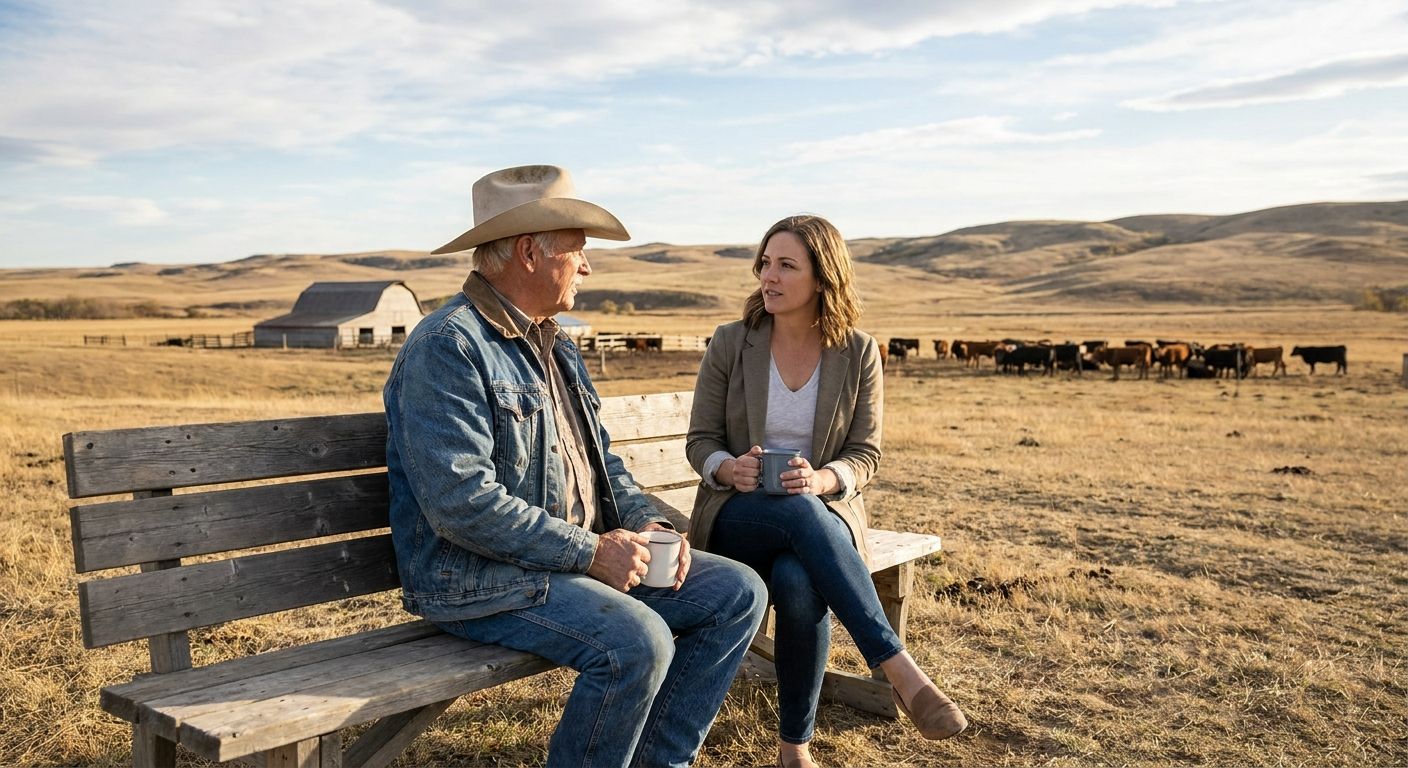
Farming and ranching in southern Alberta means running on adrenaline for six weeks straight, then crashing the second the crop is in the bin — individual therapy for farmers and ranchers has to work around that rhythm, not against it.
- Individual therapy for farmers and ranchers works only if scheduling bends around calving, seeding, and harvest — virtual sessions solve this. Book it.
- Brandon Boorsma Counselling in Lethbridge treats stoicism as a strength to work with, not a symptom to fix. Start here.
- Skip generic EAP hotlines for ongoing farm stress; a one-off call rarely covers financial pressure that lasts a season. Skip.
- High-functioning anxiety in producers who ‘look fine’ at the co-op needs a specific approach, not a general wellness app. Consider.
Why this matters
Rural Alberta has fewer therapists per capita than Calgary or Edmonton, and most of them keep office hours that assume you work a desk job. If you're calving at 4 a.m. or hauling grain until dark, a 9-to-5 counselling slot in 2026 is functionally useless.
The stigma is real too. Admitting you're struggling in a community where everyone knows your yard and your last three crop years feels riskier than it does in a city. That's not a reason to skip therapy — it's a reason to pick the right kind of provider.
I'm Brandon Boorsma, a Registered Psychologist based in Lethbridge, and this guide breaks down what actually matters when you're choosing individual therapy as someone who runs a farm or ranch instead of sitting at a desk.
Who this is for
This is written for producers across southern Alberta — grain farmers watching hail clouds build over a crop that's three weeks from combine, cattle ranchers managing a herd through a rough calving season, and anyone carrying the financial and physical weight of a family operation. It's for the person who's fine talking about equipment repairs but goes quiet the second the conversation turns to how they're actually doing.
What to look for in therapy for farmers and ranchers
Scheduling that survives calving and harvest
A therapist who books six weeks out with no flexibility doesn't understand your calendar. Calving season alone runs six to eight weeks each spring, and harvest can eat every daylight hour from late August through October — therapy has to fit around that, with virtual options and evening slots, not the other way around.
Comfort with rural culture, not just rural geography
Living near Lethbridge isn't the same as understanding what it means to lose a calf, watch a hailstorm flatten a crop, or carry debt against next year's yield. A therapist who treats your stoicism as pathology instead of a survival trait learned on the land will lose you in session one.
A practical, action-oriented approach
Producers generally don't want to talk in circles for months. Cognitive behavioural therapy (CBT) works well here because it gives you something concrete to try between sessions — a plan, a script for a hard conversation, a way to interrupt a spiral at 2 a.m. when the numbers won't stop running.
Privacy in a small community
In a town where your neighbour's cousin works at the same elevator you sell to, confidentiality isn't abstract. Virtual sessions from your own truck or office solve half of this problem by keeping you out of a waiting room where someone might recognize you.
Room for financial and weather-related stress specifically
Generic anxiety treatment doesn't always address stress tied to input costs, commodity prices, or a drought year cutting your yield in half. Look for a therapist who's willing to talk about the actual sources of the pressure, not just the anxiety symptoms sitting on top of it.
Willingness to work with your family, not around it
Farm and ranch stress rarely stays contained to one person — it moves through a marriage, a succession plan, a set of adult kids deciding whether to come back to the operation. A therapist who only ever asks about you in isolation misses half the picture.
Book a session that fits your season
Virtual and in-person individual therapy available in Lethbridge, Alberta.
Where to start: session types that fit farm life
The 3 a.m. worry pick. Individual therapy for anxiety-related insomnia targets the specific pattern where your body is exhausted from a sixteen-hour day but your mind won't quit running the numbers on next year's crop. If you're lying awake doing math on input costs instead of sleeping, this is the entry point. Start here.
The burnout pick. Therapy for work-related stress and burnout fits the producer who's past ordinary tired and into the flat, numb exhaustion that shows up after a hard calving season or a harvest that ran late into October. It's built for people who can't just take a week off to recover. Consider.
The looks-fine pick. Therapy for high-functioning anxiety in professionals works for the operator who's holding it together in front of the crew and the bank but is wound tight underneath — the person everyone assumes is fine because the crop got off and the cattle look good. Consider.
The general entry pick. Individual therapy for anxiety in Lethbridge is the broadest starting point if you're not sure which specific pressure is driving the stress yet — financial, weather, family, or all three at once. Start here.
The transition pick. Individual therapy for major life transitions covers succession planning, retirement off the operation, or a forced sale — moments where the identity tied up in the land shifts and there's no clean roadmap for how to feel about it. Wait on this one until you're actually in that transition; it's not the right starting point for day-to-day stress.
What to avoid
- A one-time EAP call. Employee-assistance hotlines are built for a single crisis conversation, not a season of financial and weather stress that doesn't let up. They look like a fix; they're a stopgap.
- In-person-only providers an hour's drive from your yard. A great therapist in Calgary does you no good if getting there costs you half a day during seeding or calving. Confirm virtual availability before you book.
- Wellness apps aimed at anxiety in general. Meditation and journaling apps are fine as a supplement, but they don't touch the specific financial and operational pressure that comes with running a farm or ranch through a bad year.
You can be strong enough to run cattle through a snowstorm and still need someone to talk to.
Verdict comparison
| Option | Best for | Format | Verdict |
|---|---|---|---|
| Anxiety-related insomnia therapy | 3 a.m. financial worry loops | Virtual or in-person | Start here |
| Work-related stress and burnout therapy | Post-calving, post-harvest exhaustion | Virtual or in-person | Consider |
| High-functioning anxiety therapy | Looks fine, isn't | In-person preferred | Consider |
| General anxiety therapy (Lethbridge) | Unsure where stress originates | Virtual or in-person | Start here |
| Major life transition therapy | Succession, retirement, forced sale | Virtual or in-person | Wait until transition is active |
FAQ
What’s the best type of therapy for farmers and ranchers dealing with stress?
Cognitive behavioural therapy (CBT) works well for producers because it’s practical and gives you concrete tools between sessions, not just conversation. It fits people who want a plan more than open-ended reflection.
Is individual therapy confidential in a small town like Lethbridge?
Yes — sessions are private, and virtual appointments let you avoid a waiting room entirely if that’s a concern in a community where people know your business. Confidentiality applies the same way it would in any city practice.
How much does therapy for farmers and ranchers cost in Alberta in 2026?
Rates vary by session type and length, so check current pricing directly on the practice’s site before booking. Some extended health plans through farm associations also cover part of the cost.
Can I do therapy sessions virtually if I live outside Lethbridge?
Yes, virtual sessions are available and are often the more practical option for producers who don’t have time to drive into town during calving or harvest. You can join from your truck, shop, or home office.
How do I know if I need therapy or if it’s just a rough season?
If the stress from a bad crop year, calving losses, or debt is affecting your sleep, your marriage, or your ability to function past a few weeks, that’s a signal worth acting on. A single hard week is normal; months of it isn’t.
What if I don’t have time for therapy during calving or harvest?
Book shorter or less frequent sessions during peak season rather than skipping altogether, and shift to a more regular schedule once the workload eases. Virtual options make this far easier to fit around an unpredictable day.
Does therapy help with succession planning stress?
Yes — succession decisions carry identity and family weight beyond the paperwork, and individual therapy can help you sort through that before it turns into conflict at the kitchen table. It won’t replace a lawyer or accountant, but it addresses the emotional side those professionals don’t.
Is it normal for farmers and ranchers to avoid therapy?
It’s common, largely due to rural stigma around admitting struggle, but avoidance tends to let stress compound across seasons instead of resolving it. Producers who do start therapy often say the hardest part was the first phone call, not the sessions themselves.
One last thing
The producers who get the most out of individual therapy in 2026 aren't the ones in crisis — they're the ones who book a session in a slower month, like January or early February, before seeding pressure builds. Waiting until harvest is already underway to start therapy means starting from behind.
Related guides