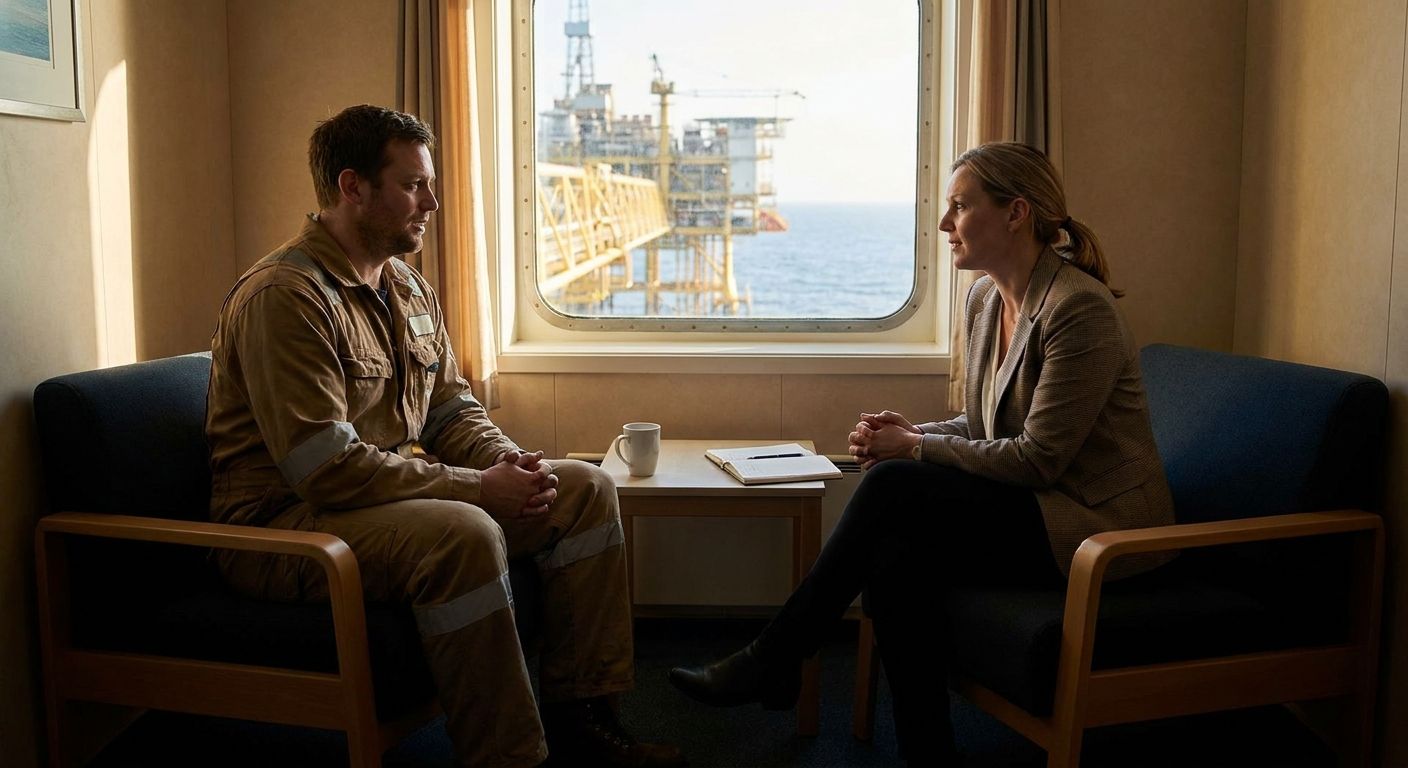
Two weeks on the rig, two weeks home — and the version of you your family sees on day nine of the break off is rarely the version that clocked out. Individual therapy for oil and gas workers on rotation deals with that gap directly, instead of pretending a standard weekly appointment can hold it.
- Therapy for oil and gas workers on rotation works best with virtual sessions booked around hitch dates, not fixed weekly slots.
- Shift-adapted CBT handles camp isolation and reintegration stress better than open-ended talk therapy.
- Couples counselling matters as much as individual sessions when one partner works away from home for two weeks at a stretch.
- Skip programs requiring weekly in-person visits — they don’t survive a 14-on, 14-off schedule.
Why this matters
Rotational work in Alberta's oil and gas sector runs on schedules most counselling practices never design around: 14 days on and 14 off, 20-and-8, or camp postings that stretch longer than that. Coming home doesn't reset anything on day one — it usually takes three or four days before a worker stops scanning for hazards that aren't there anymore.
Heading into 2026, more workers in southern Alberta's oil and gas sector are specifically asking for virtual sessions, because a Tuesday-at-4pm appointment is useless to someone who won't have reliable cell service again until the 15th of the month. That's the actual problem worth solving: which kind of therapy support holds up against a rotation schedule, and which kind quietly falls apart by week three.
Who this is for
This is written for rig hands, pipeline crews, camp workers, and FIFO oil and gas employees living on rotation out of southern Alberta — and for their partners, who are carrying a different but connected version of the same strain. If you're coming home to a house that suddenly feels unfamiliar, snapping at people you love for no clear reason, or dreading the drive back to camp more than the camp itself, this is your situation.
The closest match on my roster to this exact problem is individual therapy for shift workers with irregular schedules, built around calendars that don't look like anyone else's.
What to look for in therapy for oil and gas workers on rotation
Session times that bend around your hitch
A therapist who only offers Tuesday 10am or Thursday 2pm doesn't understand rotation work — full stop. Look for someone offering virtual sessions and flexible booking windows around your days off, because a schedule that assumes a five-day work week will fail you by your second hitch.
Experience with isolation, camp life, and reintegration stress
Camp isolation and the jolt of coming home aren't the same thing as general stress, and they don't respond to generic advice. A therapist who's worked with rotational or shift-based clients before will ask about the specific mechanics of your schedule instead of treating every two weeks off as a vacation.
A structured approach, not open-ended talk
Cognitive behavioural therapy (CBT) gives you tools you can actually use between sessions that might be two or three weeks apart. Open-ended talk therapy depends on continuity you don't have when you're off-grid for half the month, so a structured approach matters more here than it does for someone seeing a therapist every Wednesday.
Confidentiality that holds up in a small industry
Oil and gas crews are small worlds — everyone knows everyone, and word travels fast on a camp bus. Confidentiality isn't a nice-to-have; it's the difference between someone actually booking a session and someone deciding it's not worth the risk of being seen at a counsellor's office in Lethbridge.
Room for your partner, not just you
Rotation work strains the relationship as much as it strains the worker. A therapist who can also see you and your partner together — or point you toward that option — is doing more for your actual life than one who only ever talks to you alone.
Support paths worth considering
The schedule-matched pick. Individual therapy for shift workers with irregular schedules exists for exactly this calendar problem — booking around a 14-on/14-off pattern instead of forcing you into a fixed weekly slot. If your days off shift every rotation, this is the starting point. Buy.
The burnout pick. Therapy for work-related stress and burnout targets the specific exhaustion of high-hour, high-hazard work — the kind where you're technically off but still running on adrenaline three days into your break. If you've stopped enjoying your days off, start here. Buy.
The relationship pick. Couples counselling for partners who work away from home addresses the specific friction of one partner being gone for two weeks and then suddenly, fully present again. This is the option most rotational workers skip and most partners wish they hadn't. Consider.
The men's mental health pick. Therapy for men managing anxiety and depression speaks directly to an industry where admitting you're struggling still carries a stigma most crews haven't shaken off. If naming the problem out loud is the hardest part, this is the entry point. Consider.
The performance pick. Therapy for high-functioning anxiety in professionals fits the worker who looks fine on shift, hits every safety check, and is running on fumes underneath. It's less about crisis and more about catching the slide before it becomes one. Consider.
What to avoid
- Weekly in-person-only programs. They assume a 9-to-5 life and will have you missing more sessions than you attend once your rotation kicks back in.
- "Just push through it" framing. Camp isolation and reintegration stress are specific, addressable problems — not something to grit your teeth past for another three years.
- One-size relationship advice. Generic couples tips ignore the actual mechanics of reintegration friction after 14 days apart, which is a different problem than everyday conflict.
“The hardest twelve hours of a rotation aren’t on the rig — they’re the twelve hours after you walk back through your own front door.”
How the options compare
| Support path | Format | Best fit | Verdict |
|---|---|---|---|
| Individual therapy for shift workers with irregular schedules | Virtual or in-person | Unpredictable rotation calendars | Buy |
| Therapy for work-related stress and burnout | Virtual or in-person | Exhaustion that doesn't lift on days off | Buy |
| Couples counselling for partners who work away from home | Virtual, both partners | Relationships strained by absence | Consider |
| Therapy for men managing anxiety and depression | Virtual or in-person | Reluctance to name what's going on | Consider |
| Therapy for high-functioning anxiety in professionals | Virtual or in-person | Looking fine, running on empty | Consider |
Book a session around your rotation
Virtual and in-person sessions available in Lethbridge, Alberta.
FAQ
What’s the best therapy for oil and gas workers on rotation?
Virtual, CBT-based individual therapy scheduled around your hitch dates works best for rotational crews. It gives you concrete tools to use between sessions, which matters when appointments might be two or three weeks apart.
Can I do therapy sessions while I’m still on camp?
Cell and internet access on most camps is limited, so most rotational workers book virtual sessions during their days off rather than while on shift. Ask about flexible rebooking if your rotation shifts unexpectedly, which happens often in this industry.
Is virtual therapy as effective as in-person for shift workers?
Virtual therapy delivers the same CBT-based approach as in-person sessions, and for rotational schedules it’s often the only format that’s actually usable. In-person remains an option in Lethbridge for the weeks you’re home.
How do I know if I need therapy or just a normal reset day?
If it’s taking longer than three or four days to feel like yourself after every rotation, or if you’re avoiding your family instead of reconnecting with them, that’s a pattern worth addressing rather than waiting out. A first session is usually enough to tell the difference.
Will couples counselling help if my partner and I only see each other every two weeks?
Yes — couples counselling for partners who work away from home is built for exactly this rhythm. Sessions focus on the reintegration friction of going from apart to together, which is a different skill than resolving everyday disagreements.
How much does individual therapy cost in Alberta in 2026?
Costs vary by provider and session length, so check current rates directly with the counsellor you’re considering. Many employers in the oil and gas sector include Employee Assistance Program coverage for a set number of sessions — check yours before booking privately.
Is it normal to feel disconnected from family after a long rotation?
Yes, this is one of the most common concerns workers raise, and it has a name: reintegration stress. It’s addressable with the right support and doesn’t mean something is wrong with your relationship.
Do I need to be in crisis to book a session?
No. Most rotational workers who book therapy are functioning fine on shift and struggling quietly with burnout, isolation, or relationship strain — not in crisis. Catching it early is easier than waiting for it to become one.
One last thing
The part of rotation work that surprises workers most isn't the camp isolation — it's how long the coming-home adjustment actually takes. Most people expect day one back to feel like relief. In practice, the nervous system often needs three or four full days to stop running on shift-mode before anything resembling normal family life resumes. Planning around that lag, instead of being blindsided by it every single rotation, is one of the simplest changes a worker can make in 2026.
Related guides