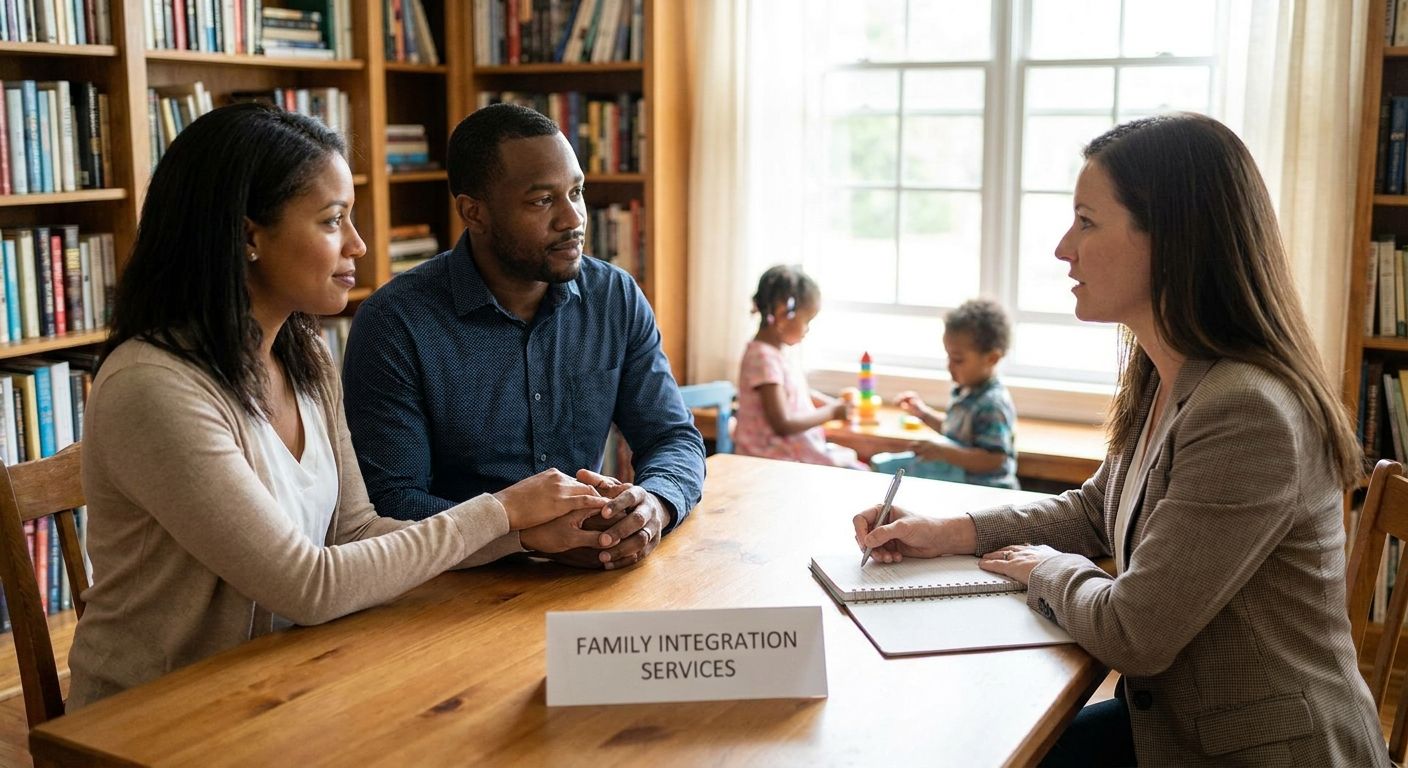
Blending two families before the wedding even happens means your premarital counselling has to cover ground a standard program never touches. This guide breaks down what premarital counselling for blended families should prioritize, what a generic curriculum gets wrong once kids from previous relationships are in the picture, and where to focus session time before the marriage certificate is signed.
- Premarital counselling for blended families needs co-parenting logistics on the agenda, not just communication drills. Priority.
- Second marriages carry different pressure points than first marriages — generic premarital curriculum skipping remarriage patterns is a Skip.
- Discipline authority and stepparent roles cause more early blended-family conflict than money does. Address before the wedding.
- Individual anxiety support alongside couples work is worth adding when one partner is carrying stress from a previous divorce.
Why this matters
Statistics Canada's most recent census on family structure found roughly one in ten couple families with children in Canada is a stepfamily, and that share has been rising for decades. Most premarital counselling programs were built around first marriages with no kids yet in the household — they cover budgeting, in-laws, and communication styles, but skip custody schedules, discipline authority, and the loyalty conflicts that come with a stepparent role.
Couples blending families walk into the marriage with two existing parenting systems already running. Skipping that work in premarital sessions doesn't make it disappear — it just means the first real fight happens after the wedding instead of before it, when there's less room to adjust.
Who this is for
This applies to engaged couples where one or both partners have children from a previous relationship, and the household will combine two sets of parenting habits, two extended families, and often two co-parenting arrangements with an ex-partner still in the picture. It also applies to couples remarrying later in life whose kids are older but still adjusting to a new family structure. If you're planning a wedding with no children involved on either side, couples counselling for blended families covers different terrain than what you need — a standard premarital track will serve you better.
What to look for in premarital counselling for blended families
Co-parenting logistics addressed directly, not glossed over
A program that treats "parenting styles" as one generic session isn't built for blended families. You need dedicated time on discipline authority — who enforces what, when, and how a stepparent's role differs from a biological parent's — plus how the relationship with an ex-partner's household gets handled without becoming a constant source of tension.
Room for each partner's kids, even if they're not in the room
Children don't attend premarital counselling, but their perspective should shape it. Sessions that ignore how a 7-year-old or a 15-year-old will experience the new household are missing the point of the exercise — the wedding is one event, the blended household is the daily reality afterward.
Financial planning across two family systems
Blended families often carry child support, split custody costs, or separate savings earmarked for kids from a previous relationship. Premarital counselling for blended families needs a financial conversation that accounts for two systems merging into one budget, not the simpler "combine your accounts" conversation a first-marriage program assumes.
A therapist who names remarriage patterns specifically
Ask directly whether the program addresses topics to cover in premarital counselling sessions that are specific to second marriages — loyalty conflicts, ex-partner boundaries, and stepparent identity. A generic first-marriage curriculum recycled for every couple is a warning sign, not a feature.
A realistic timeline before the wedding date
Starting premarital counselling in the final weeks before the wedding leaves no room to actually apply what comes up. Most therapists recommend starting three to six months out — enough time to have the harder conversations and revisit anything that surfaced the first time, rather than rushing through it once.
Individual support running alongside the couple's sessions
One partner may still be carrying anxiety or grief from a previous divorce that shapes how they show up in the new relationship. That's not something couples sessions alone will resolve — it often needs its own space.
Where sessions need to focus first
Co-parenting boundaries and discipline authority — the non-negotiable. This is the single most common source of conflict in blended households in year one, ahead of money or in-laws. If your premarital counselling doesn't map out who disciplines whom and how the biological parent versus stepparent roles work, this gets fought out in real time in front of the kids instead. Priority.
Remarriage-specific relationship patterns — the pattern generic programs miss. Remarriage counselling addresses loyalty conflicts and comparison to a previous relationship directly, which a standard premarital curriculum built for first-time couples doesn't touch. Couples remarrying in 2026 who skip this tend to relearn the same lesson their first marriage taught them, just with new consequences. Priority.
Financial merging across two family systems — the quiet dealbreaker. Money conflict in blended families usually isn't about spending habits; it's about whose kids get what and from which account. Naming this before the wedding, not after the first joint tax season, keeps resentment from building silently. Address before the wedding.
Individual anxiety or grief support alongside couples work — the overlooked add-on. If one partner is still processing the end of a previous marriage, individual therapy for anxiety can run in parallel with premarital sessions so that unresolved stress isn't relitigated inside every couples conversation. Worth adding, not mandatory.
Stepparent identity and role clarity — easy to skip, expensive to skip. Couples who never define what the stepparent's authority actually looks like tend to default to avoidance, which reads as disengagement to the kids and resentment to the biological parent. This deserves its own session, not a five-minute mention. Priority.
Book premarital counselling before the wedding rush
Sessions in Lethbridge for couples blending families, in person or virtual.
What to avoid
- A generic premarital package with no blended-family content. If discipline authority, ex-partner boundaries, and stepparent identity aren't named in the program outline, it wasn't built for your situation — it was built for a first marriage with no kids yet.
- Waiting until the kids move in to address household roles. Sorting out authority and routines after the wedding, once everyone's already living under the same roof, is harder than sorting it out beforehand with lower stakes.
- Treating the ex-partner relationship as a topic to avoid in session. Co-parenting logistics with a former spouse don't disappear because you're remarrying — pretending they're irrelevant to premarital counselling just delays the conversation to a worse moment.
Comparison: standard premarital counselling vs. blended-family focused
| Criteria | Standard premarital program | Blended-family focused counselling | Verdict |
|---|---|---|---|
| Co-parenting and discipline authority | Rarely addressed directly | Dedicated session time | Priority |
| Ex-partner boundaries | Not covered | Named explicitly | Priority |
| Financial planning | Joint budgeting only | Two-system merging, child support factored in | Address before wedding |
| Stepparent identity | Not covered | Direct role-clarity work | Priority |
| Individual stress support | Not included | Available alongside couples work | Worth adding |
| Timeline before wedding | Often 1-2 sessions late | 3-6 months recommended | Plan ahead |
FAQ
What makes premarital counselling for blended families different from regular premarital counselling?
Premarital counselling for blended families adds work on co-parenting logistics, discipline authority, stepparent identity, and financial planning across two family systems. Standard premarital programs built for first marriages typically skip all four.
When should we start premarital counselling before a wedding involving kids?
Three to six months before the wedding date is the general recommendation, giving enough time to revisit harder topics like co-parenting boundaries after they first come up. Starting in the final weeks leaves no room to apply what surfaces.
Is premarital counselling worth it for a second marriage?
Yes, especially because second marriages carry loyalty conflicts and comparison patterns that first-marriage curriculum doesn’t address. Remarriage-specific counselling names these directly instead of treating the relationship like a first-time pairing.
How do you handle discipline roles between a biological parent and stepparent?
Discipline authority should be defined explicitly before the wedding, not worked out live in front of the kids. The biological parent typically holds primary discipline authority early on, with the stepparent’s role clarified through direct conversation, not assumption.
Should kids from a previous relationship be part of premarital counselling sessions?
Kids don’t usually attend the sessions directly, but their daily experience of the new household should shape what gets discussed. A program that never accounts for how children will experience the blended family is missing a core piece of the preparation.
Can individual therapy help alongside premarital counselling for blended families?
Yes, particularly when one partner is still processing anxiety or grief from a previous relationship. Running individual sessions alongside the couple’s premarital work keeps that unresolved stress from surfacing inside every joint conversation.
What’s the biggest mistake couples make in blended-family premarital counselling?
Treating the ex-partner relationship and co-parenting logistics as topics to avoid in session. Skipping them doesn’t remove the conflict, it just delays it until after the wedding when the stakes are higher.
One last thing
The conflict that ends up costing blended families the most isn't money or in-laws — it's an undefined stepparent role that gets avoided instead of discussed. Naming it directly in premarital counselling, even once, changes how the first year of the marriage plays out far more than another session on communication styles would.
Related guides