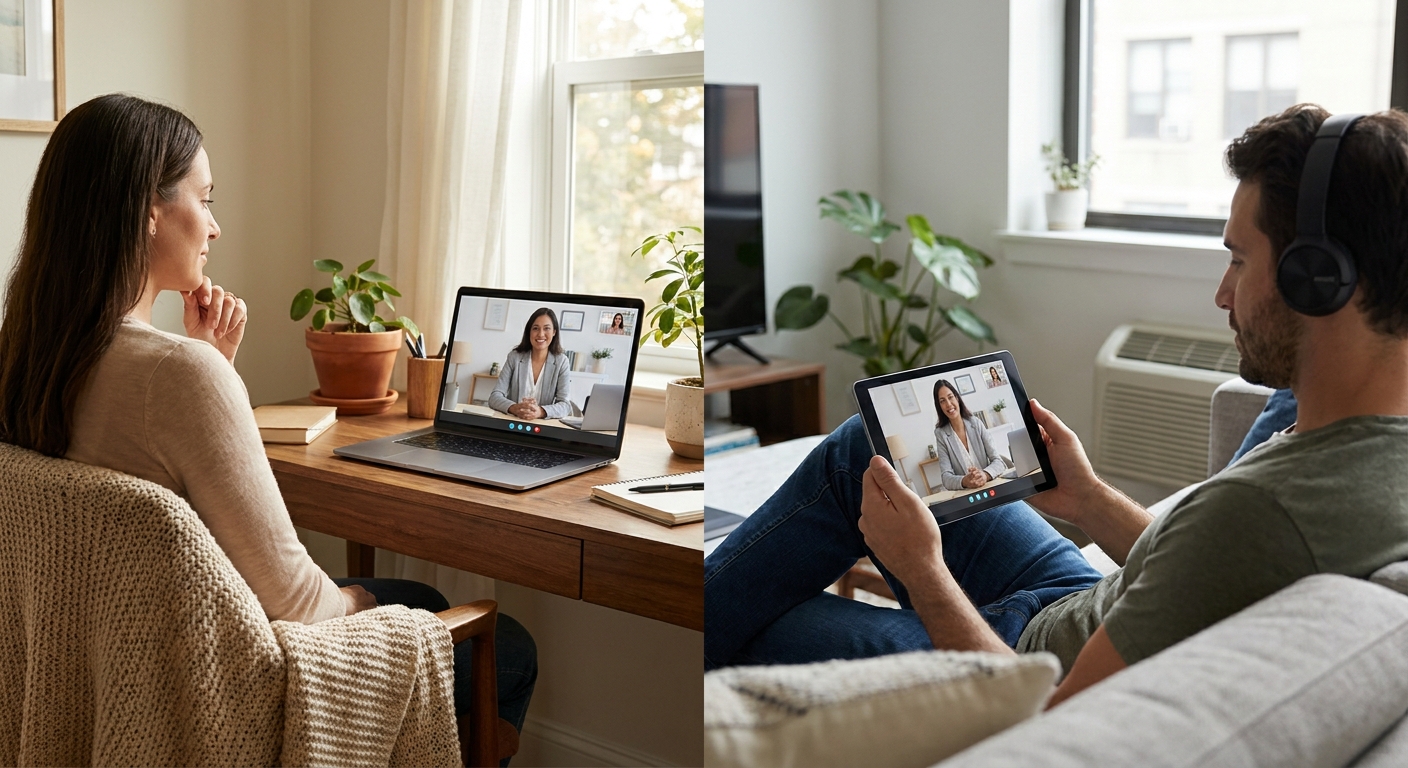
Long-distance couples counselling only works if the format matches the actual gap between you — time zones, how often you see each other, and how much conflict has stacked up between visits. The right setup handles repair work over video and saves in-person time for connection, not damage control.
- Couples counselling for long-distance relationships works best as weekly 50-minute virtual sessions, not sporadic check-ins.
- Visit-based intensives suit couples who see each other less than once a month. Consider, don’t rely on alone.
- Waiting for the next visit to address a fight is the most common mistake long-distance couples make in 2026.
- A therapist who treats distance as a scheduling variable, not the root problem, gets better results than a generalist.
Why this matters
Distance changes what counselling has to solve. A couple who sees each other every weekend needs different support than a couple three time zones apart who meets twice a year. Virtual couples counselling closes that gap for a lot of long-distance pairs, but the format still has to fit your actual calendar, not an ideal one.
The couples who struggle most in 2026 aren't the ones with the biggest distance — they're the ones using the wrong cadence for their distance. A weekly video session works for a 3-hour time difference. It falls apart at 12 hours unless one of you is willing to talk at 6 a.m. or midnight.
Who this is for
This guide is for couples who live in different cities, provinces, or countries and are trying to keep the relationship functional between visits — dating couples working toward closing the distance, spouses separated by work or school, and military or FIFO couples on rotation schedules. If you're already asking how to know if you and your partner need couples counselling, distance is usually amplifying a communication problem that already existed, not creating a new one.
It's not for couples in the same city who just have busy schedules — that's a cadence problem, not a distance one, and it calls for a different fix.
What to look for in couples counselling for long-distance relationships
A format built for your time zone gap, not a generic weekly slot
A 12-hour gap means someone is always talking outside normal hours. Ask upfront how session times get set and whether the therapist has run sessions across a similar gap before — a scheduling mismatch kills consistency faster than any relationship issue.
A cadence you can actually sustain
Weekly 50-minute sessions work for most couples with a manageable gap. Couples who see each other only a handful of times a year often do better with biweekly video sessions plus stacked intensives during visits — pick the rhythm you'll still be doing in three months, not the one that sounds most committed on day one.
A therapist who separates "distance" from "the actual conflict"
Distance gets blamed for problems that would exist anyway — mismatched communication styles, trust questions, differing timelines for closing the gap. A good long-distance counselling process names the underlying issue directly instead of treating "we're far apart" as the diagnosis.
Structure for the conversations you're avoiding on video calls
Couples on video default to logistics and skip the harder stuff — jealousy, timelines, what happens if a job offer changes the plan. Sessions need built-in structure that forces those topics onto the table instead of letting eight video calls in a row stay surface-level.
A plan for what happens when the distance ends
Most long-distance counselling has an expiration date built in — a move, a graduation, a lease ending. The process should include a plan for the transition to living together, since that shift causes its own friction and is a different problem than the distance itself.
Top picks: formats that actually work for long-distance couples
Weekly virtual sessions — the steady default. One 50-minute video session, same time every week, no more than a day or two of scheduling flexibility. This is the right call when the time zone gap is under 6-8 hours and both partners can commit to a fixed slot. Best fit for most long-distance couples in 2026.
Visit-based intensives — the compressed catch-up. Two or three sessions stacked into a single in-person visit, timed around whatever's been building up between trips. Works well when visits happen every 6-8 weeks and video calls in between are informal, not structured. Consider — pair it with occasional check-in calls so nothing waits three months to surface.
Biweekly video plus structured homework — the middle path. Sessions every other week, with specific conversation prompts to run between them so the relationship isn't only worked on when a therapist is present. This suits couples juggling a rough time zone overlap where weekly sessions aren't realistic. Consider if you're both disciplined enough to actually do the homework.
Waiting for the next visit to deal with conflict — the wait-and-see approach. No scheduled support between trips, just hoping things sort themselves out in person. This is the format most couples default to by accident, not by choice, and it's the one that lets small issues calcify into resentment. Skip.
Before the first session, it helps to know what to ask. Review questions to ask before your first couples counselling session so you're not figuring out the format on the fly.
Book long-distance couples counselling
Virtual sessions built around your schedule, not the other way around.
What to avoid
- Treating text-based check-ins as therapy. Daily texts feel like connection but skip the harder, slower conversations a real session forces. They're a supplement, not a substitute.
- Assuming distance-related anxiety is only about the relationship. Sometimes one partner's spiraling about the distance is a standalone anxiety pattern that needs its own attention — see individual therapy for anxiety if that's showing up outside the relationship too.
- Booking sessions only during high-conflict weeks. Counselling that only shows up after a blowup teaches both partners that support is a crisis response, not a maintenance habit.
Verdict comparison
| Format | Time zone gap it suits | Cadence | Verdict |
|---|---|---|---|
| Weekly virtual sessions | Under 6-8 hours | Weekly, 50 minutes | Best fit |
| Visit-based intensives | Any gap, infrequent visits | 2-3 sessions per visit | Consider |
| Biweekly video + homework | 8-12 hours | Every other week | Consider |
| Wait-and-see (no sessions) | Any | None | Skip |
FAQ
Is couples counselling for long-distance relationships worth it in 2026?
Yes, when the session format matches your time zone and visit schedule. Long-distance couples who use weekly virtual sessions typically catch conflict earlier than couples who wait for in-person visits to talk things through.
How often should long-distance couples do counselling?
Weekly 50-minute sessions work for most couples with a manageable time zone gap. Couples with infrequent visits often do better with biweekly sessions plus stacked intensives when they’re together.
Can virtual couples counselling replace in-person sessions entirely?
For most long-distance couples, yes — virtual sessions handle the ongoing communication and conflict work. In-person time is better spent on connection than repeated logistics.
What’s the biggest mistake long-distance couples make in counselling?
Waiting until a visit to address conflict instead of dealing with it as it happens. Issues that sit unaddressed for weeks between visits tend to compound rather than resolve on their own.
Does a big time zone difference make counselling harder?
It changes the format more than it changes the outcome. A 12-hour gap usually rules out a fixed weekly slot and points toward a rotating schedule or biweekly sessions instead.
Is long-distance relationship anxiety different from regular relationship anxiety?
Often it’s the same underlying pattern, amplified by distance and less certainty about day-to-day details. Sessions that treat distance as the whole problem tend to miss the actual anxiety pattern underneath.
How do you know if it’s the distance or the relationship itself?
If the same conflicts would exist living in the same city, distance is amplifying an existing issue, not causing it. Counselling that separates the two usually moves faster than one that blames the distance for everything.
One last thing
The couples who do best with long-distance counselling aren't the ones with the shortest gap — they're the ones who picked a cadence they could keep every single week without renegotiating it. A biweekly session you actually attend beats a weekly session you cancel half the time.
Related guides