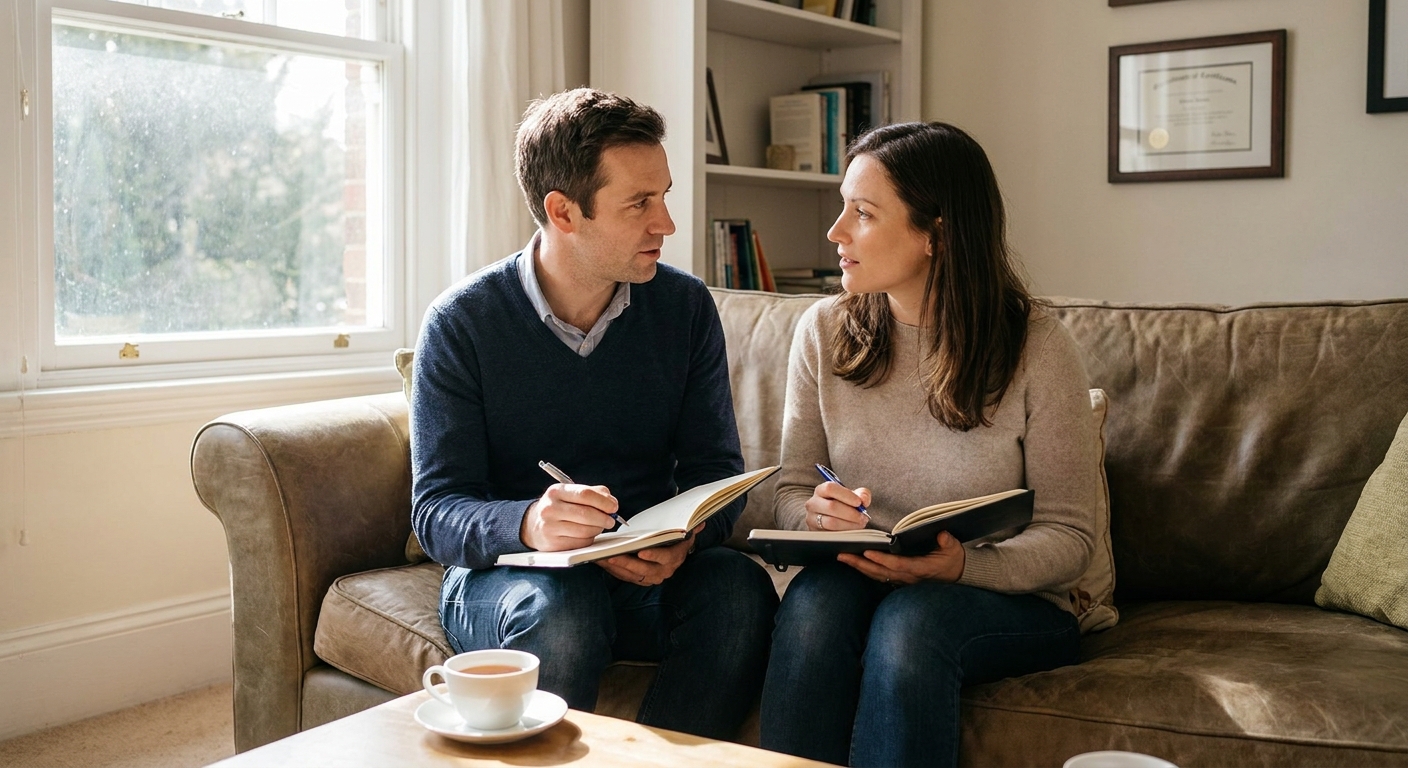
Walking into a first couples counselling session without a plan wastes half the hour on logistics you could have sorted out by email. The right questions before you book tell you whether a therapist's approach fits your relationship — and whether you're both ready to answer honestly once you're in the room.
- Ask about therapeutic approach first — Gottman Method and CBT lead to very different first sessions in 2026.
- Confirm individual-vs-joint session structure before booking; some therapists see partners separately first.
- Skip questions about guaranteed outcomes — no licensed psychologist will promise a fixed timeline.
- Virtual couples counselling removes the scheduling excuse for busy households; ask if it’s offered before ruling it out.
- Premarital and early-relationship couples need different intake questions than couples managing conflict or infidelity.
Why this matters
Most couples show up to a first session nervous, unsure who should talk first, and unclear on what the therapist is actually going to do with the next fifty minutes. That uncertainty is normal — but it's also avoidable.
Asking the right questions before you book, or in the first five minutes of session one, sets expectations for both partners and for relationship counselling for conflict or whatever brought you in the door. A Registered Psychologist should be able to answer every question below in plain language, without dodging or padding with jargon. If they can't, that tells you something too.
How I organized these questions
These categories come from what actually gets asked in intake calls and first sessions with couples in Lethbridge, Alberta — not a generic checklist pulled from a wellness blog. Each category maps to a real decision point: approach, structure, cost, confidentiality, and fit for your specific situation, whether that's newlywed adjustment, a blended family, or trust repair after infidelity.
Questions are ranked by how much they change the outcome of session one. A question about cancellation policy matters, but it won't reshape how you experience therapy the way a question about method or individual-session structure will.
The ranked questions, in order of importance
1. "What's your therapeutic approach, and why does it fit us?"
This is the single most useful question you can ask. A therapist using the Gottman Method will run structured assessments and homework between sessions; one using Cognitive Behavioural Therapy (CBT) will focus more on thought patterns and communication scripts in-session. Neither is wrong, but they feel very different week to week.
A good answer takes under thirty seconds and names the method directly. Ask this now — before you book, not after session one.
2. "Do we meet together every time, or do you see us individually too?"
Some couples counselling models build in individual sessions alongside joint ones, especially when trust and infidelity recovery is the issue. Others keep every session joint from day one. This changes what you should prepare to say and how much privacy you'll have to raise something you haven't told your partner yet.
Couples working through trust and infidelity recovery especially need to know this upfront — the structure affects disclosure timing. Ask this early, ideally at booking.
3. "What does a typical first session actually cover?"
You want a concrete answer, not a vague "we'll get to know each other." A solid response names intake questions, a brief history of the relationship, and what each partner hopes to get out of the process. If the therapist can only describe it in abstractions, that's worth noting.
Ask this now — it tells you whether session one will feel productive or like small talk.
4. "How do you handle communication breakdown specifically?"
Communication problems are the most common reason couples book a first session in 2026, and the right therapist should have a direct answer — not a generic "we'll work on listening." Ask what tools or frameworks get used when conversations turn into arguments mid-session.
If you're already dealing with recurring shutdowns or escalation, couples counselling for communication breakdown should address this directly in the first conversation. Ask this if communication is your primary issue — otherwise it's optional.
5. "Is virtual counselling available, and does it work as well as in-person?"
Busy schedules, shift work, and one partner traveling are the most common reasons couples delay booking. A therapist offering virtual couples counselling for busy schedules removes that excuse entirely, and video sessions in 2026 run on stable, private platforms that don't compromise the work.
Ask this if scheduling is your barrier. Skip it if you're both flexible and prefer in-person.
6. "How do you handle premarital or early-relationship prep differently from conflict work?"
Couples booking before a wedding need a different first session than couples in active conflict. Premarital work focuses on expectations, roles, and communication patterns before problems calcify; conflict work focuses on de-escalation and repair. If you're preparing for marriage, this question tells you whether the therapist actually differentiates the two.
Couples getting ready for the wedding itself should look at how to prepare for premarital counselling as a couple before the first appointment. Ask this if you're engaged or newly married.
7. "What happens if only one of us is fully on board?"
This one gets skipped constantly, and it shouldn't. A lot of first sessions happen with one reluctant partner in the room. Ask how the therapist works with mismatched motivation — it's common, and a psychologist who's handled it before will have a real answer instead of pretending it doesn't happen.
Ask this if one partner is hesitant. Otherwise it's a lower priority.
8. "Can you guarantee this will fix our relationship?"
Here's the one to leave off your list. No licensed psychologist will or should promise a specific outcome or timeline — relationships involve two people making choices, and therapy supports that work rather than controlling it. If anyone answers yes to this, treat it as a warning sign, not reassurance.
Skip this question. Ask instead what progress typically looks like by session four or five.
“If a therapist can’t describe their approach in one sentence, that’s not humility — it’s a gap you’ll feel by session three.”
Comparison: which questions to ask when
| Question category | When to ask | Why it matters | Verdict |
|---|---|---|---|
| Therapeutic approach | Before booking | Sets expectations for structure and pace | Ask now |
| Individual vs. joint sessions | At booking | Affects privacy and disclosure timing | Ask early |
| First session content | Before booking | Confirms session one is productive, not just intro chat | Ask now |
| Communication-specific methods | If communication is the core issue | Tells you if the fit matches your problem | Situational |
| Virtual availability | If scheduling is a barrier | Removes the most common reason couples delay | Situational |
| Premarital vs. conflict focus | If engaged or newly married | Confirms differentiated prep, not generic advice | Situational |
| Guaranteed outcomes | Never | No credible psychologist promises a fixed result | Skip |
Where to start
- Book a consultation call first if one's offered. A short call before your first paid session lets you ask the approach and structure questions without pressure.
- Bring your questions in writing. Couples forget half their list once the session starts; a notes app list keeps you both on track.
- Don't wait for a crisis. Couples who ask these questions early — before conflict peaks — tend to get more out of session one than couples who book reactively.
Ready to book your first session?
Get answers to these questions directly before your first appointment.
FAQ
What’s the best question to ask before couples counselling?
Ask what therapeutic approach the psychologist uses and why it fits your situation. This one question reveals more about what session one will feel like than any other question on the list.
Should we ask about cost before the first session?
Yes, confirm session cost and any insurance coverage before booking, not during session one. It avoids an awkward conversation once you’re already in the room in 2026’s typical fee structures.
Is it normal for only one partner to want counselling?
Yes, this is common and worth raising directly with the therapist before or during the first session. A psychologist experienced with mismatched motivation will have a specific plan for working with a hesitant partner.
How do we know if a therapist’s approach is right for us?
Ask them to describe their method in one or two sentences and compare it against your specific issue, whether that’s communication breakdown, infidelity recovery, or premarital prep. A vague answer is a signal to keep looking.
Can we ask for individual sessions instead of joint ones?
Many couples counselling models include individual sessions alongside joint ones, particularly for trust and infidelity work. Ask this directly at booking so you know the structure before session one starts.
Is virtual couples counselling as effective as in-person?
Virtual couples counselling works well for busy schedules and shift work, using stable video platforms that preserve privacy. Ask specifically if it’s offered before ruling out counselling due to scheduling conflicts.
What should we avoid asking a couples counsellor?
Avoid asking for a guaranteed outcome or fixed timeline. No licensed psychologist can promise a specific result, since therapy supports the work rather than controlling the choices each partner makes.
How soon should we book after deciding we need counselling?
Book as soon as you’ve agreed to try it rather than waiting for the next argument. Couples who ask their questions and book early tend to get more out of the first few sessions than those who wait for a crisis point.
One last thing
The question couples skip most often is the one about individual sessions — and it's usually the one that matters most once trust or infidelity is part of the picture. Ask it before you book, not after you're already sitting across from your partner with something unsaid.
Related guides
- Marriage counselling for newlyweds
- Couples counselling for reconnecting after growing apart
- Couples counselling for blended families
- Couples counselling for new parents