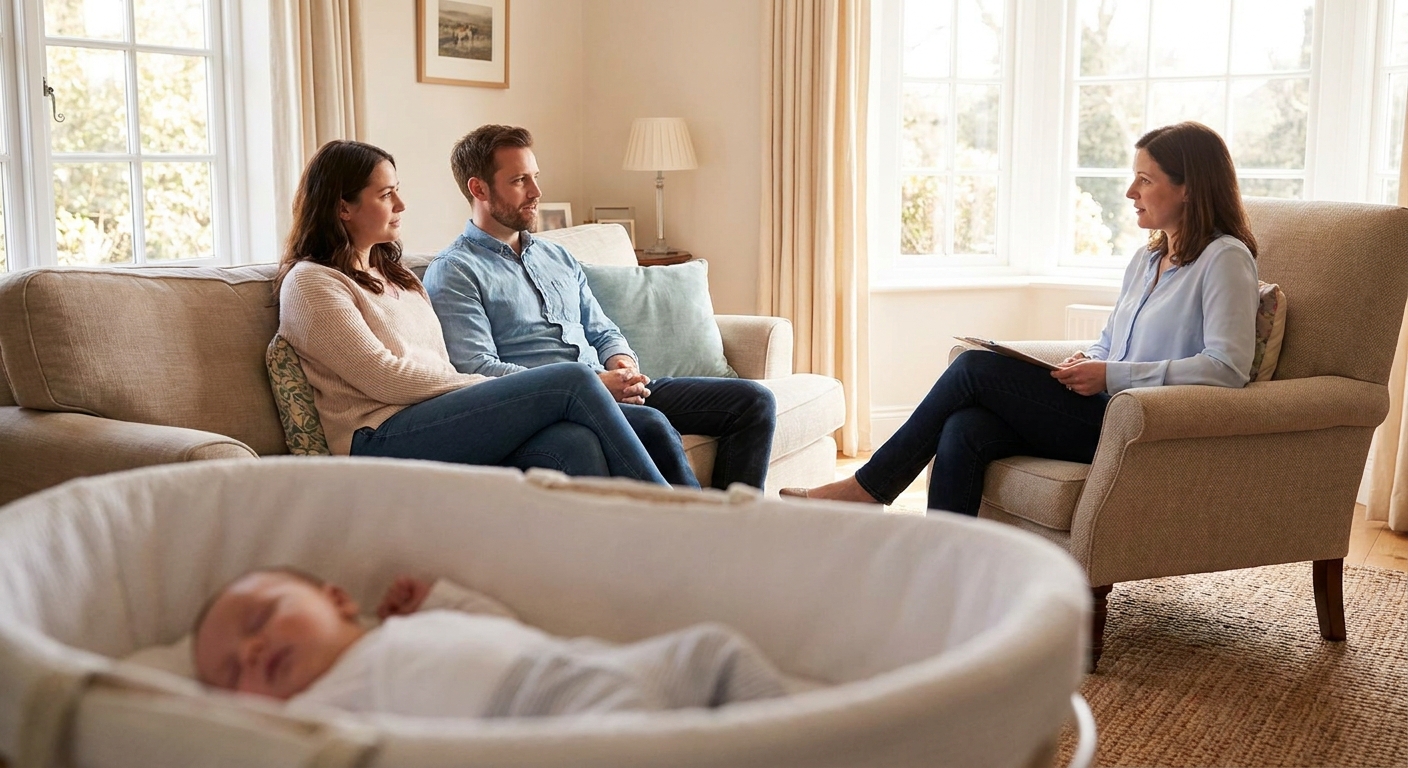
Couples counselling for new parents deals with a specific kind of strain: sleep deprivation, a lopsided division of labour, and a newborn who outranks the relationship on every priority list. This guide breaks down what to look for in couples counselling for new parents, when to add individual sessions, and which option to book first.
- Couples counselling for new parents works best when it targets the specific fight (division of labour, sleep, sex) rather than generic communication tips.
- Start with couples counselling for communication breakdown before anything else — it’s the entry point most new-parent couples actually need.
- If one partner’s anxiety or depression is driving the conflict, pair joint sessions with therapy for postpartum anxiety in new mothers or therapy for new dads and paternal mental health.
- Skip unlicensed ‘relationship coaching’ in year one postpartum — the stakes with a newborn in the house are too high for that.
- A Registered Psychologist trained in Gottman method and CBT, like Brandon Boorsma in Lethbridge, is the safer call over a generalist mediator.
Why this matters
The first year after a baby arrives changes a relationship faster than almost any other life event. Two adults who used to negotiate as equals suddenly split unequal shifts, unequal sleep, and unequal recovery — and most of the resentment shows up as small arguments about dishes or diaper changes, not the real issue underneath.
Generic couples counselling for new parents in 2026 often misses this. A therapist who treats new-parent conflict the same way they'd treat a ten-year marriage's communication rut is going to waste your limited sessions. Couples counselling for communication breakdown built around the specific pressures of new parenthood — night feeds, mental load, touched-out partners — gets to the actual problem faster.
Who this is for
This is for couples in the first two years of parenthood who are arguing more than they used to, feel like roommates instead of partners, and haven't had an honest conversation about the division of labour since the baby came home. It's also for couples where one partner is showing signs of postpartum anxiety or depression that's spilling into every disagreement, and for couples in or near Lethbridge, Alberta who want in-person sessions that fit around nap schedules instead of a nine-to-five office hour.
What to look for in couples counselling for new parents
Postpartum-specific experience, not generic marriage counselling
A therapist who's worked with new parents knows the difference between a couple fighting because they're incompatible and a couple fighting because they're both running on four hours of sleep. That distinction changes the whole approach — and it's the first question worth asking before you book.
A structured method, not open-ended venting
Gottman method and CBT give couples specific tools — a script for the 2 a.m. argument about who gets up, a framework for the resentment that builds after six months of unequal parental leave. Open-ended talk therapy without structure tends to circle the same fight every session without resolving it.
Room for individual sessions alongside joint work
New-parent conflict is rarely just relational. One partner's postpartum anxiety, or the other's undiagnosed depression, needs its own space — not just fifteen minutes of a fifty-minute couples session. Look for a practice that can pair couples work with individual sessions when that's what's actually needed.
Screening for postpartum anxiety and depression, not just relationship health
A counsellor who only asks "how's the marriage" and skips "how are you sleeping, and how are you feeling day to day" is missing half the picture. Postpartum mental health and relationship health feed each other directly in the first year.
Scheduling that works around an infant, not against one
If a practice only offers 9-to-5 weekday slots with no flexibility, that's a scheduling mismatch for anyone managing an infant's routine. Ask about evening availability and how sessions handle a last-minute cancelled babysitter.
Top picks for new parents
Couples counselling for communication breakdown — the starting point
Most couples arguing over logistics that turn personal need this first. Sessions run roughly 50 minutes and focus on the specific pattern — who brings up what, who shuts down, who escalates — rather than a general "tell me about your relationship" intake. Book this first if the fights are about dishes and feeds but the anger feels bigger than the dishes.
Therapy for postpartum anxiety in new mothers — for mom's side of it
When the anxiety in the house is loudest coming from mom — racing thoughts at 3 a.m., intrusive worry about the baby, irritability that doesn't match the moment — therapy for postpartum anxiety in new mothers runs as individual work alongside the couples sessions, not instead of them. In the first 12 months postpartum, this combination catches problems couples counselling alone can miss. Book alongside joint sessions, not as a replacement for them.
Therapy for new dads and paternal mental health — the option most couples skip
Paternal postpartum depression and anxiety get talked about far less, and most dads never bring it up unless a therapist asks directly. Therapy for new dads and paternal mental health exists specifically because that gap costs relationships time they don't get back in year one. Book this if dad's stress, withdrawal, or irritability has been going untreated for more than a few weeks.
The option to hold off on
Couples where the conflict has escalated into repeated shouting matches, not just tension, usually need a conflict-focused track before communication-skills work will stick — that's a different starting point, and it's worth naming to your counsellor upfront rather than defaulting to the general option. And couples where one partner is struggling less with the relationship and more with losing their sense of self since becoming a parent may get more out of individual work first, then joint sessions once that ground is steadier.
What to avoid
- Skip unlicensed "relationship coaching" for postpartum-stage conflict — a Registered Psychologist trained in Gottman method and CBT is the safer bet when a newborn is in the house and the stakes are higher than a normal rough patch.
- Skip any counsellor who never asks about sleep or mental health screening. New-parent conflict without that context gets treated like any other couple's communication problem, and it isn't.
- Skip a one-size-fits-all intake. If the first session doesn't distinguish between "we're exhausted and snapping at each other" and "we don't trust each other anymore," the treatment plan that follows will be generic too.
Ready to start couples counselling?
Book a session with a Registered Psychologist in Lethbridge.
Verdict comparison table
| Option | Best for | Format | Verdict |
|---|---|---|---|
| Communication breakdown counselling | Logistics fights that turn personal | Joint, 50-min sessions | Book this first |
| Postpartum anxiety support (mom) | Anxiety driving the conflict | Individual, alongside couples work | Book alongside |
| Paternal mental health support (dad) | Dad's untreated stress or withdrawal | Individual, alongside couples work | Book alongside |
| Conflict-focused couples work | Escalated arguments, not just tension | Joint sessions | Consider if fights are frequent |
| Individual life-transition work | Identity loss in new parenthood | Individual | Consider before joint work |
FAQ
What is couples counselling for new parents?
It’s couples counselling that focuses on the specific pressures of the first one to two years of parenthood — sleep deprivation, division of labour, and identity changes — rather than generic relationship communication. A Registered Psychologist in Lethbridge, Alberta typically structures sessions around these patterns using methods like Gottman and CBT.
Is couples counselling for new parents different from regular marriage counselling?
Yes. New-parent conflict is usually driven by exhaustion, unequal parental leave, and postpartum mental health rather than long-standing incompatibility. A counsellor experienced with new parents screens for anxiety and depression alongside relationship issues, which a generalist marriage counsellor may not do.
Should new parents do couples counselling or individual therapy first?
It depends on what’s driving the conflict. If one partner has untreated postpartum anxiety or depression, individual sessions running alongside couples work tend to move faster than couples counselling alone in 2026.
How soon after having a baby should couples start counselling?
There’s no fixed rule, but couples who wait until resentment has built for a year usually need more sessions to unwind it than couples who address the pattern in the first few months. Early intervention in the first 12 months postpartum tends to be more efficient.
Do dads need their own therapy alongside couples counselling?
Not automatically, but paternal postpartum depression and anxiety go undiagnosed often because dads rarely raise it unprompted. If withdrawal or irritability has lasted more than a few weeks, pairing individual sessions with couples counselling addresses both sides of the relationship.
What method does a Registered Psychologist use for new-parent couples counselling?
Gottman method and cognitive behavioural therapy (CBT) are common structured approaches, giving couples concrete tools for recurring arguments rather than open-ended discussion. Brandon Boorsma, a Registered Psychologist in Lethbridge, uses both depending on the couple’s specific conflict pattern.
Can couples counselling help if one partner is depressed after having a baby?
Couples counselling addresses the relationship strain, but postpartum depression itself usually needs individual treatment running in parallel. Treating only the relationship while the underlying depression goes unaddressed tends to stall progress.
One last thing
The couples who make the fastest progress in 2026 aren't the ones with the calmest fights — they're the ones who name the actual pattern ("we fight about dishes but it's really about who gets to sleep") in the first session instead of the third. If you can say that sentence out loud before you book, you're already ahead of most couples who walk in.
Related guides