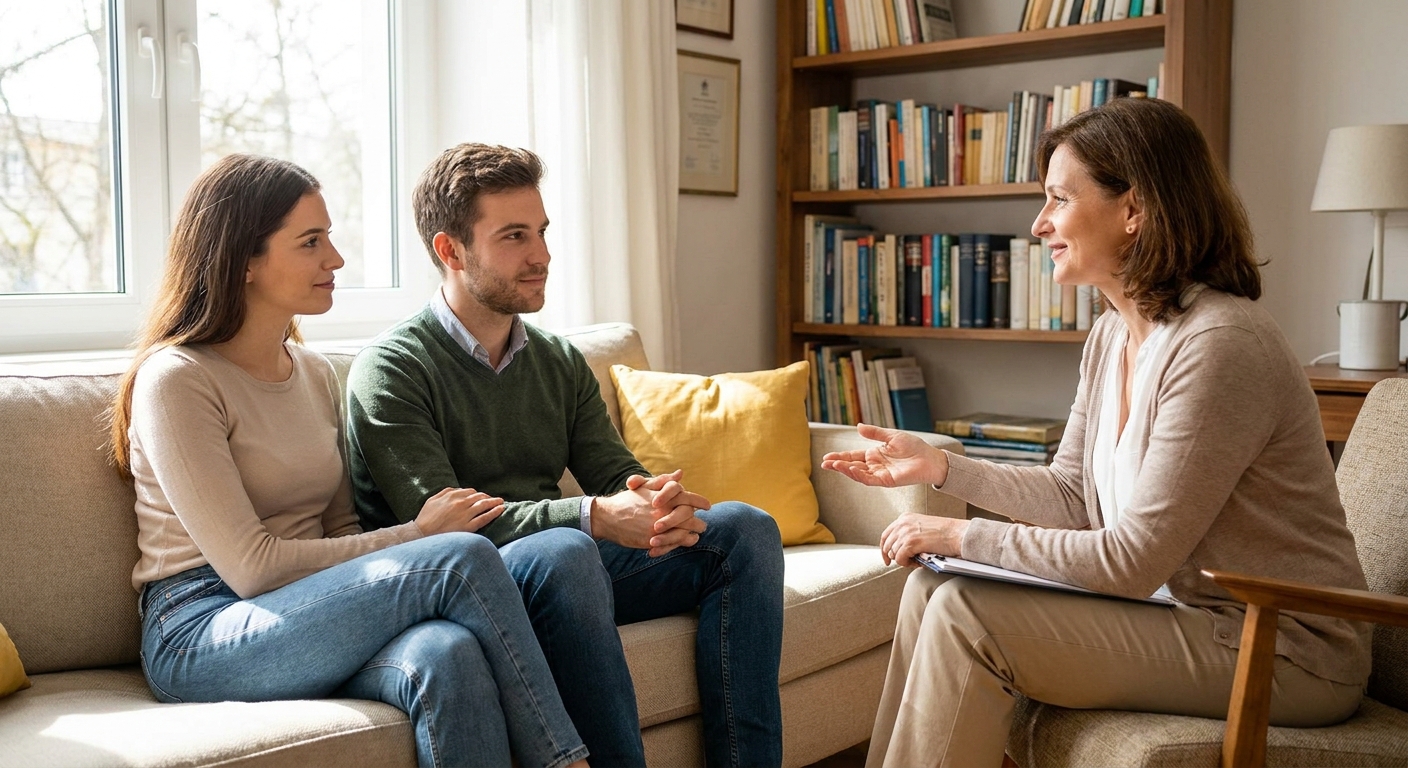
Marriage counselling for newlyweds is a different service than crisis counselling. It's about building repair skills before your first real disagreement becomes a permanent script, not untangling years of resentment after the fact. Here's what actually helps in year one of marriage, what to skip, and where to start.
- Marriage counselling for newlyweds works best when booked in the first 12 months, before conflict patterns set. Start here, not after the first big blowup.
- Communication breakdown counselling beats generic date-night advice for couples navigating their first arguments as spouses. Verdict: start here.
- Relationship conflict counselling is for couples who keep fighting about the same thing in a new marriage. Verdict: book this.
- Premarital counselling carryover sessions in year one reinforce what you already learned before the wedding. Verdict: consider.
- Marriage advice apps and books without a licensed professional are a poor substitute for couples counselling. Verdict: skip.
Why this matters
Most couples wait years before booking a first session, long enough for a small disagreement about dishes to turn into a recurring argument about respect. Newlyweds who book earlier catch the pattern while it's still just a pattern, not an identity one spouse has assigned to the other.
The first 12 months of marriage force two people to build shared systems for money, in-laws, division of labor, and conflict style, often for the first time under one roof. That's a different job than repairing a decade of accumulated hurt, and it calls for communication breakdown counselling built around the specific friction points newlyweds hit, not generic marriage advice.
Marriage counselling for newlyweds isn't a sign the marriage is in trouble. It's maintenance, the same way you'd get an oil change before the engine seizes rather than after.
Who this is for
This guide is for couples married within the last year or two, in or near Lethbridge, Alberta, who are hitting their first real friction points: money decisions, in-law boundaries, differing conflict styles, or the gap between how each of you was raised to handle disagreement. Some of you did premarital counselling before the wedding and want to keep that momentum going. Others skipped it entirely and are catching up now that daily life together has revealed the gaps.
What to look for in marriage counselling for newlyweds
A Registered Psychologist, not just a life coach
Licensing means accountability, supervised training, and a body of practice like CBT or the Gottman Method behind the sessions, not opinions dressed up as expertise. For newlyweds specifically, this matters because the patterns you set in year one tend to stick, so the feedback you're building on needs to be reliable.
A structured method, not just "tell me how you feel"
A session built around the Gottman Method or CBT gives you concrete tools like repair attempts and specific communication drills, not just validation. Newlyweds benefit from structure because you're building new habits from scratch, and vague talk therapy doesn't hand you anything to practice at home.
Room to name the specific issue
Communication breakdown, relationship conflict, and premarital carryover are three different problems that need three different areas of focus. A counsellor who lets you name the actual issue, rather than defaulting to a one-size-fits-all curriculum, gets you to progress faster.
Timing that beats waiting for a crisis
Starting counselling within the first 12 months of marriage, before a pattern calcifies into an identity, is far more effective than waiting until year 5 when the same fight has repeated fifty times. Early sessions are shorter and fewer because the pattern hasn't hardened yet.
Space for individual patterns alongside the relational ones
Sometimes what looks like a marriage problem is actually one spouse's anxiety, a major life transition, or leftover stress from a career change bleeding into the relationship. Counselling that can flex between couples work and individual work, like individual therapy for major life transitions, catches that instead of misdiagnosing it as a couple issue.
Ready to start counselling as a couple?
Book a session with a Registered Psychologist in Lethbridge, Alberta.
Where newlywed couples get the most value
Communication breakdown counselling — the one most newlyweds need first
This is where most first-year couples start, because the actual fight is rarely about the topic on the surface. It's about how the conversation goes off the rails within the first two minutes. Newlywed couples who address this within 90 days of noticing the pattern tend to resolve it faster than those who wait through a second or third year of the same argument. Verdict: start here.
Relationship conflict counselling — for couples who fight about the same thing
Hook: this is for the couple who can predict the fight before it starts. If you can finish each other's sentences during an argument because you've had it a dozen times, relationship conflict counselling targets the loop itself rather than the topic du jour. It typically pairs well with communication work rather than replacing it. Verdict: book this.
Premarital counselling carryover — for couples who did the prep work
Hook: for couples who invested time before the wedding and don't want that work to fade. A check-in built on how to prepare for premarital counselling as a couple revisits the same framework a few months into marriage, when theory meets the reality of shared bills and shared laundry. Verdict: consider.
Individual therapy for life transitions — for the spouse struggling solo
Hook: sometimes one partner is quietly drowning in the adjustment, career move, or new-city stress that came with the wedding, and it's showing up as irritability at home. Individual therapy for major life transitions addresses that directly instead of routing it through couples sessions where it doesn't fit. Verdict: consider.
Marriage advice apps and books without a professional — the wildcard that isn't really counselling
Hook: these feel like progress because you're doing something, but a book can't respond to your specific argument pattern the way a licensed clinician can. They're fine as supplementary reading alongside actual sessions, not as a replacement for them. Verdict: skip.
What to avoid
- Waiting for a crisis. Booking only after an affair, a major blowup, or a separation threat means starting from a much deeper hole than starting in year one would have required.
- Choosing an unlicensed "marriage coach" over a Registered Psychologist. Coaching can be well-intentioned, but it doesn't carry the training or accountability that comes with a psychology license, and newlyweds building foundational patterns need reliable guidance.
- Treating a relational problem as purely individual. If one spouse goes to individual therapy alone for what's actually a couples issue, like chronic miscommunication, the pattern often persists because only half the system is being addressed.
Verdict comparison table
| Session focus | Best for | When to start | Verdict |
|---|---|---|---|
| Communication breakdown counselling | First arguments that spiral fast | Within 90 days of noticing the pattern | Start here |
| Relationship conflict counselling | Recurring fights about the same topic | Year one, once the loop repeats 2-3 times | Book this |
| Premarital counselling carryover | Couples who did prep work pre-wedding | 3-6 months into marriage | Consider |
| Individual therapy for life transitions | One spouse struggling with adjustment | As soon as it's noticed | Consider |
| Apps and books alone | Supplementary reading only | Never as a stand-alone plan | Skip |
FAQ
Is marriage counselling for newlyweds necessary if we’re not fighting?
Yes, in the sense that it’s maintenance, not repair. Couples who start marriage counselling for newlyweds in year one before a real conflict emerges tend to build better repair habits than couples who wait for a crisis to force the issue.
How soon after the wedding should we start counselling?
Within the first 12 months is ideal, before daily patterns around money, in-laws, or conflict style calcify. Waiting until year 3 or 4 usually means addressing a pattern that’s already repeated dozens of times.
What’s the difference between premarital counselling and marriage counselling for newlyweds?
Premarital counselling happens before the wedding and focuses on expectations and readiness. Marriage counselling for newlyweds happens after, once real shared life like bills, chores, and in-laws has revealed where those expectations don’t match reality.
Does marriage counselling for newlyweds work if only one spouse wants to go?
Individual therapy can still help the spouse who attends, especially if a personal issue like anxiety or a life transition is driving the friction. But couples-focused issues, like a communication pattern, need both people in the room to change fully.
How much does marriage counselling cost in Lethbridge in 2026?
Rates vary by provider and session length, so check current pricing directly with the practice you’re considering. Many extended health plans in Alberta include coverage for registered psychologist sessions under mental health benefits, so it’s worth confirming your specific plan.
Can individual therapy help a marriage even if we don’t go together?
Yes, when the issue is genuinely individual, like work-related stress or a personal life transition spilling into the relationship. It’s less effective for issues that are relational at the root, like a recurring communication breakdown between both spouses.
How many sessions do newlywed couples typically need?
It varies by the specific issue and how long the pattern has been running, since a fight that’s happened twice needs less unpacking than one that’s happened fifty times. Starting in year one generally means fewer sessions than starting after years of an entrenched pattern.
Is couples counselling only for marriages already in trouble?
No, it’s increasingly used as preventive care in the first year or two of marriage, the same logic as a check-up before symptoms appear. Newlywed couples who use it this way are addressing patterns while they’re still small.
One last thing
The couples who get the most out of marriage counselling for newlyweds aren't the ones with the biggest problems. They're the ones who show up in the first 12 months, before either of you has built a story about who the other person is during a fight. That timing advantage matters more than which specific method a counsellor uses.
Related guides