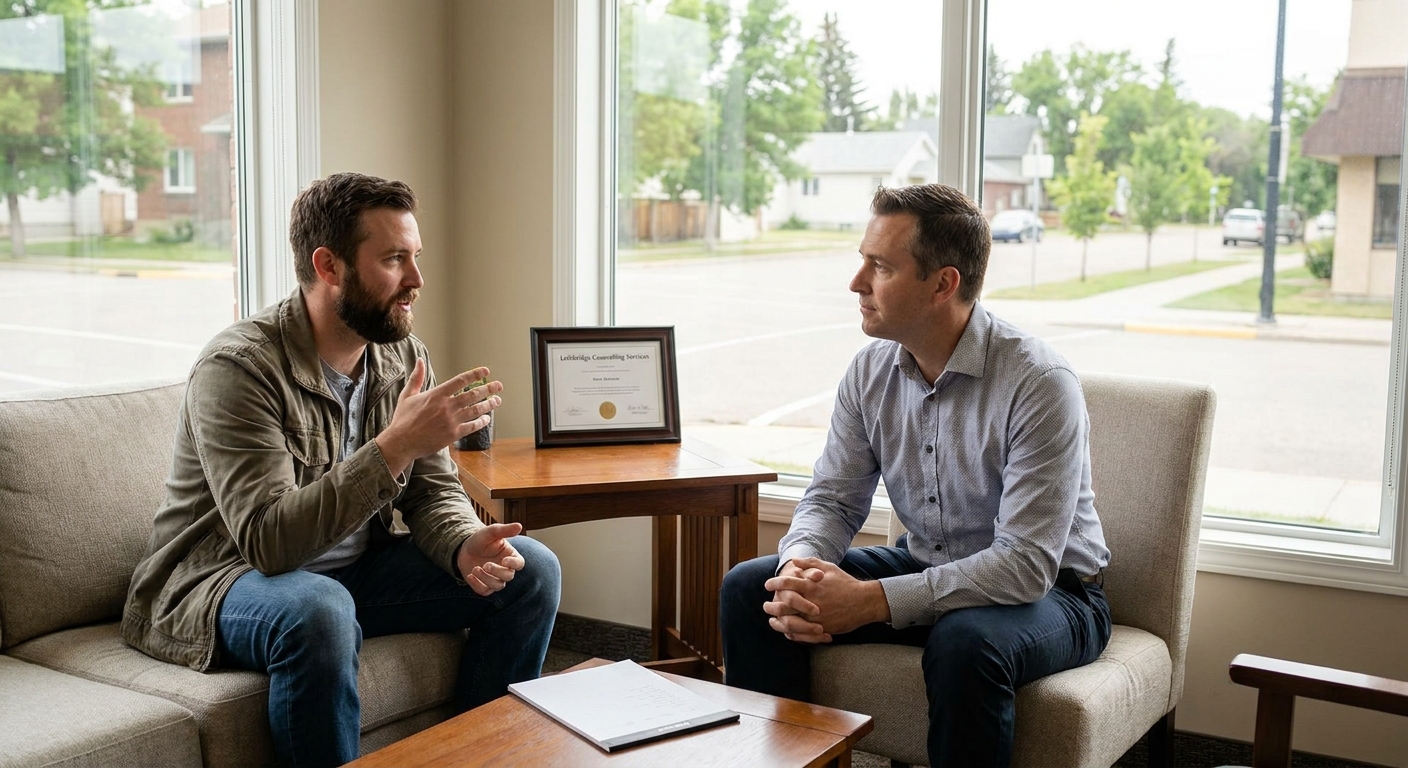
Most men in Lethbridge don't walk into counselling for "relationship counselling." They walk in because a partner said something that landed hard, because work is bleeding into everything else, or because a new baby flipped their whole life and nobody warned them. This guide breaks down what to look for in relationship counselling for men in Lethbridge in 2026 and which specific path fits your situation.
- Lethbridge relationship counselling for men works best when the therapist treats male-specific presentations of anxiety, depression, and conflict avoidance directly.
- Therapy for men managing anxiety and depression at Brandon Boorsma Counselling is the default starting point for individual work in 2026 — Book.
- New dads dealing with identity shift and sleep-deprived conflict should start with paternal mental health support, not generic stress advice — Book.
- If the conflict is with a partner and not just inside your own head, couples counselling for relationship conflict is the right track, not individual work — Consider.
- Skip anything marketed as generic ‘men’s coaching’ with no clinical license behind it — Wait.
Why this matters
Men wait longer to book relationship counselling than women do, and by the time they do, the issue has usually compounded: the anxiety turned into withdrawal, the work stress turned into short-fusedness at home, the unspoken resentment turned into a partner who's done waiting for things to change. Brandon Boorsma Counselling works with men in Lethbridge on exactly this pattern — not generic "talk it out" sessions, but structured work aimed at the specific thing that's actually breaking down.
The mistake most men make isn't avoiding therapy altogether. It's picking the wrong entry point — couples counselling when the real issue is untreated anxiety, or individual venting sessions when the actual problem is a communication pattern that needs both partners in the room. Getting the entry point right in 2026 saves months.
Who this is for
This guide is for men in Lethbridge and southern Alberta who are dealing with relationship strain — with a partner, a spouse, or in the transition to fatherhood — and who want a Registered Psychologist's approach rather than a general wellness app or an unlicensed coach. It applies whether the relationship problem is the main complaint or sitting underneath something else, like burnout or a major life change.
What to look for in relationship counselling for men
A therapist who treats male-specific patterns, not generic "communication tips"
Men tend to present anxiety and depression differently than the textbook symptom list suggests — more irritability, more withdrawal, more "I'm fine" followed by silence. A counsellor who only knows the standard checklist will miss it. Look for someone who names this pattern explicitly rather than defaulting to generic communication worksheets.
Credentials that actually mean something
A Registered Psychologist designation in Alberta means regulated training, ethical oversight, and accountability that a life coach or influencer-therapist doesn't carry. In 2026, with the number of unregulated "relationship coaches" online, this distinction matters more than it used to.
A path for the individual work AND the couple's work
Relationship strain rarely lives in one person alone. The right practice offers both an individual track — for the anxiety, the burnout, the identity shift — and a couples track for when the conflict is genuinely between two people. If a provider only offers one, you'll eventually hit a wall.
Specific programs for specific triggers
Work stress that spills into the relationship needs a different starting point than a new baby that upended the household routine. A practice built around one-size-fits-all sessions will spend the first several visits just figuring out where the real problem is.
Location and format that actually fits your week
Lethbridge-based, in-person availability matters if you want a real office and a face across from you. But flexible virtual options across Alberta matter just as much if your schedule doesn't allow a weekly drive downtown.
A clear first step, not a vague "reach out and we'll figure it out"
The practices that work best in 2026 tell you upfront what the first session covers and which track you're likely headed toward, based on what you describe when you book.
Top picks by situation
The default starting point. Therapy for men managing anxiety and depression is where most relationship strain in men actually starts — not because the relationship is the problem, but because untreated anxiety or low mood makes every conflict sharper. If your partner has said "you're just not present anymore," this is the track to start on. Verdict: Book.
The one most men skip. Therapy for new dads and paternal mental health exists because the transition into fatherhood destabilizes relationships in ways almost nobody prepares men for — identity shift, sleep deprivation, and a partner who's also stretched thin. Men rarely book this one on their own, which is exactly why it gets missed. Verdict: Book.
For the guy who's fine until he's not. Therapy for work-related stress and burnout targets the version of relationship conflict that shows up as short-fusedness at home after a rough stretch at work — the guy who's holding it together at the office and coming apart at the dinner table. If burnout is doing the damage, individual anxiety sessions alone won't fix it. Verdict: Consider.
When it's not just you anymore. Couples counselling for relationship conflict is the right call once the pattern is genuinely between two people — recurring arguments, communication breakdown, or resentment that's built up over months. Individual therapy helps you personally, but it won't resolve a two-person dynamic on its own. Verdict: Consider.
The wildcard. Individual therapy for major life transitions covers the cases that don't fit neatly into anxiety, depression, or work stress — a move, a career change, a divorce, an aging parent. If your relationship strain traces back to one of these, this is the more accurate starting point than a generic anxiety track. Verdict: Consider.
Not sure which path fits?
Book an initial session and the right track gets sorted out from there.
What to avoid
- Generic "men's coaching" with no license behind it. It can sound confident and direct, but without regulated training there's no accountability if it goes badly. Skip.
- Anger management framed as the whole fix. Anger is usually the symptom, not the root cause — treating it alone without addressing the anxiety or burnout underneath just delays the real work.
- Waiting for a crisis point before trying couples counselling. The longer a couple waits, the more entrenched the pattern gets by the time they book — 2026 data on relationship counselling consistently shows earlier intervention is easier to work with than late-stage intervention.
Verdict comparison
| Path | Best for | Format | Verdict |
|---|---|---|---|
| Therapy for men managing anxiety and depression | General relationship strain tied to mood or anxiety | Individual | Book |
| Therapy for new dads and paternal mental health | New fatherhood, identity shift, sleep-deprived conflict | Individual | Book |
| Therapy for work-related stress and burnout | Short-fusedness at home tied to work pressure | Individual | Consider |
| Couples counselling for relationship conflict | Two-person communication breakdown or recurring conflict | Couples | Consider |
| Individual therapy for major life transitions | Relationship strain tied to a bigger life change | Individual | Consider |
FAQ
What is relationship counselling for men in Lethbridge?
It is individual or couples therapy that addresses relationship strain through a lens that accounts for how men typically present anxiety, stress, and conflict — often irritability and withdrawal rather than open discussion. In Lethbridge, it is delivered by a Registered Psychologist rather than an unlicensed coach.
Should I start with individual therapy or couples counselling?
Start with individual therapy if the strain traces back to your own anxiety, burnout, or a life transition; start with couples counselling if the conflict is genuinely a two-person communication pattern. Many men benefit from individual work first, then move to couples sessions once their own patterns are clearer.
Is relationship counselling only for couples in crisis?
No — in 2026, most effective counselling happens well before a crisis point, when patterns are still flexible. Waiting until a relationship is at breaking point makes the work harder, not easier.
How much does relationship counselling cost in Lethbridge?
Session fees vary by provider and format, so check current rates directly with the practice you’re considering. A Registered Psychologist’s session is a regulated clinical service, not a flat-rate coaching package.
Can new dads get counselling specifically for the transition to fatherhood?
Yes — paternal mental health support exists specifically for the identity shift, sleep deprivation, and relationship strain that come with new fatherhood. It’s one of the most under-used entry points for men in 2026 despite being one of the most relevant.
Does work stress actually affect relationships?
Yes — burnout and chronic work stress commonly show up at home as short temper, withdrawal, or reduced patience, even when the relationship itself is otherwise stable. Treating the burnout directly often resolves conflict that looked like a relationship problem on the surface.
What’s the difference between a Registered Psychologist and a relationship coach?
A Registered Psychologist in Alberta is regulated, licensed, and accountable to a professional college; a relationship coach typically has no license or standardized training requirement. That distinction matters most when the issue involves clinical anxiety or depression, not just communication style.
Is virtual counselling as effective as in-person for men?
Virtual counselling works well for ongoing sessions once a plan is established, and it removes the scheduling barrier that keeps many men from booking in the first place. Some men still prefer an in-person office for the first session, then switch to virtual for consistency.
One last thing
The men who get the most out of relationship counselling in 2026 aren't the ones who wait for the relationship to be in crisis — they're the ones who book after the first sign of a repeating pattern, while there's still room to change it. If you've noticed the same argument coming up three or four times in the last few months, that's the signal, not the crisis point.
Related guides