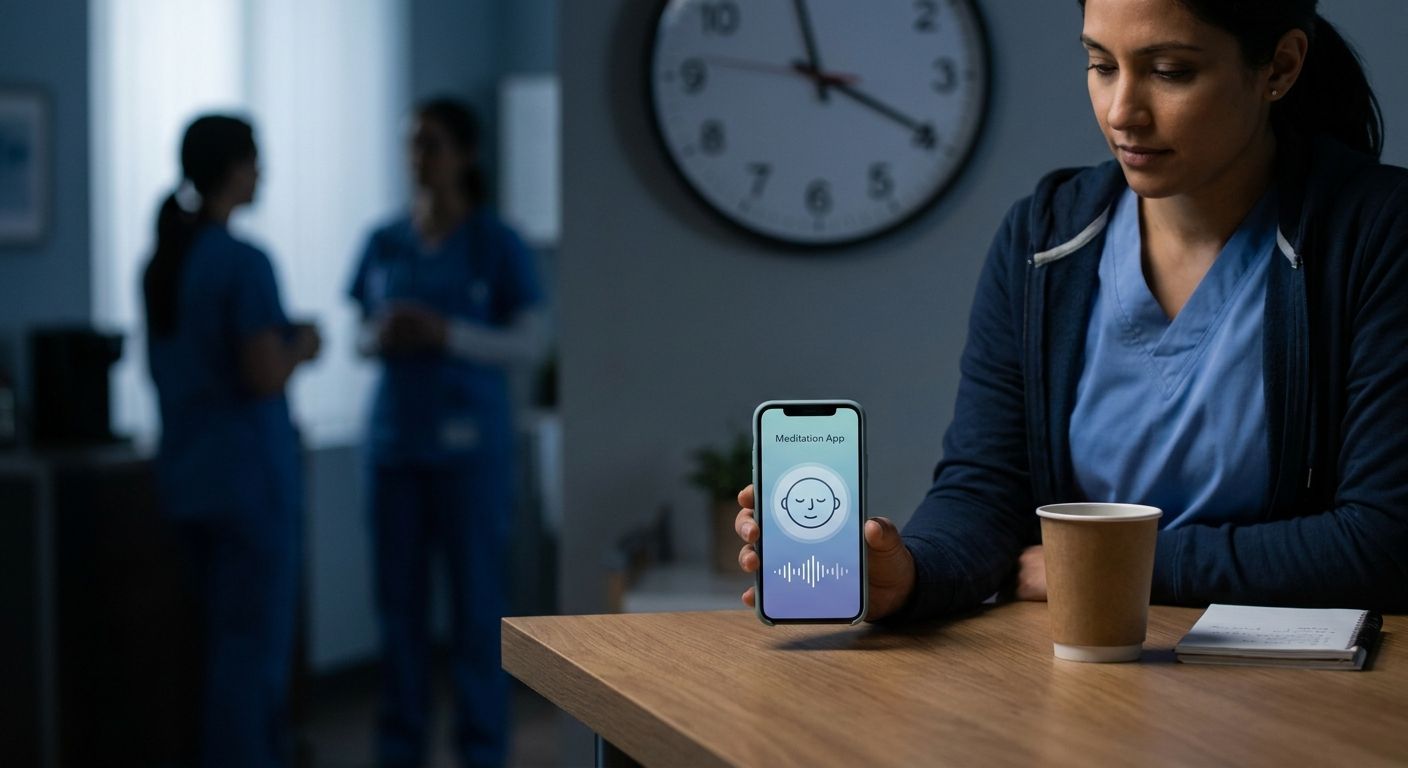
Shift work scrambles your sleep, your appetite, and your nervous system, and most mental health apps are built for people who sleep at night — this guide ranks the ones that actually work when your "morning" starts at 7pm. Sanvello ranks best overall for shift workers dealing with anxiety and mood swings tied to rotating schedules. Calm wins for night-shift sleep and wind-down routines. Insight Timer is the best free-access option for round-the-clock use. Wysa is best for quick, anonymous check-ins between shifts.
- Sanvello is the best overall mental health app for shift workers in 2026, built around CBT tools that work at 3am as well as 3pm.
- Calm and Headspace both help with sleep, but Calm’s Sleep Stories fit better with irregular wake times.
- Insight Timer’s free library works well when your break room wifi and your budget are both unpredictable.
- Wysa’s chatbot format suits shift workers who want support between shifts without booking anything.
- None of these apps replace individual therapy for shift workers with irregular schedules when anxiety or depression symptoms persist.
Why this matters
Rotating shifts, graveyard schedules, and on-call rotations push your body clock out of sync with daylight, and that mismatch shows up as irritability, poor concentration, and anxiety that doesn't track to any single event. An app that assumes you wake at 7am and wind down at 9pm is designed for a life you don't have.
The apps below get ranked on how well they hold up when your schedule flips every few days, not on marketing polish. For shift workers in Lethbridge and elsewhere, an app is a support tool between shifts — it's a different thing from individual therapy for shift workers with irregular schedules, which addresses patterns an app can only flag.
What makes the best mental health app for shift workers
- Works on any clock — content and prompts don't assume a 9-to-5 rhythm
- Evidence-based tools — CBT, mindfulness, or structured mood tracking, not just ambient sound
- Low friction — usable in a 10-minute break without a long setup
- Offline access — hospital basements, oil rigs, and warehouse floors don't always have signal
- Privacy — no requirement to loop in an employer or coworker to use it
- A path to a real person — crisis resources or a bridge to a licensed clinician when the app isn't enough
Best mental health apps for shift workers in 2026: at a glance
| App | Best for | Standout feature | Key limitation |
|---|---|---|---|
| Sanvello | Overall anxiety and mood management | CBT-based courses plus daily mood tracking | Deeper coaching features require a separate step |
| Calm | Night-shift sleep and wind-down | Sleep Stories and breathing exercises | Not built around a CBT framework |
| Insight Timer | Free, round-the-clock access | Large free library of guided sessions | Quality varies by contributor |
| Wysa | Quick anonymous check-ins | AI chatbot with CBT-style prompts | Chatbot format doesn't suit everyone |
| Headspace | Structured stress-reduction courses | Goal-based meditation series | Less tailored to irregular schedules |
| Balance | Personalized daily meditation | Adjusts sessions from daily check-ins | Needs consistent daily input to work well |
1. Sanvello: best overall for shift workers managing anxiety
Sanvello builds its core experience around cognitive behavioral therapy techniques — thought records, guided courses on anxiety and stress, and a daily mood tracker that doesn't care whether you log it at noon or 4am. The structure holds up whether you're on days, nights, or swing shifts because the exercises are self-paced rather than tied to a fixed daily schedule.
Sanvello pros:
- CBT-based courses target anxiety and low mood directly, not just relaxation
- Mood tracking works on any schedule and shows patterns over weeks
- Community feed gives peer support without requiring a live conversation
Sanvello cons:
- Coaching add-ons sit outside the core self-guided tools
- Some CBT exercises take more sustained attention than a quick break allows
Sanvello best for: shift workers who want structured tools for anxiety, not just background noise. Verdict: Buy.
2. Calm: best for night-shift sleep and wind-down routines
Calm's Sleep Stories and breathing exercises are built to help a mind slow down before sleep, and that's exactly the problem after a night shift when your body wants to stay alert past sunrise. The Daily Calm session gives a short, repeatable ritual that works whether "bedtime" is 8am or 11pm.
Calm pros:
- Sleep Stories are specifically designed to interrupt racing thoughts before rest
- Breathing exercises take under five minutes, useful during a short break
- Consistent daily structure regardless of when you use it
Calm cons:
- Lighter on clinical CBT content than Sanvello
- More oriented toward relaxation than active anxiety management
Calm best for: shift workers whose main struggle is falling asleep at odd hours. Verdict: Buy.
3. Insight Timer: best free library for round-the-clock access
Insight Timer's free tier includes a large catalog of guided meditations and talks from a wide range of teachers, available any hour, which matters when your only free ten minutes falls at 2am in a break room. The open timer function also works for silent meditation if guided content isn't your preference that night.
Insight Timer pros:
- Free core library, no schedule-based content gating
- Wide range of session lengths, from two minutes to over an hour
- Community groups organized by topic, not just time zone
Insight Timer cons:
- Content quality and depth varies since many contributors upload sessions
- No structured CBT program like Sanvello offers
Insight Timer best for: shift workers who want reliable free access without a subscription decision. Verdict: Buy.
4. Wysa: best for quick, anonymous check-ins between shifts
Wysa is a chatbot built around CBT-style prompts, and the format suits someone who wants to process a bad shift without waiting for a live conversation or explaining context from scratch. It's anonymous by design, which matters for workers in small teams where privacy about mental health is a real concern.
Wysa pros:
- Available any time, no appointment or waiting room
- CBT-style prompts help reframe a stressful shift in the moment
- Anonymous format lowers the barrier to a first conversation about how you're doing
Wysa cons:
- Chatbot interaction doesn't replace talking to a person for some users
- Human coaching sits as a separate layer from the core chatbot
Wysa best for: shift workers who want a low-pressure way to decompress right after a shift ends. Verdict: Buy.
5. Headspace: best for structured stress-reduction courses
Headspace organizes its meditation library into goal-based courses — stress, focus, sleep — and works well for someone who wants a defined program to follow rather than picking a session each time. The Sleepcasts function similarly to Calm's Sleep Stories, giving another option for winding down after an overnight shift.
Headspace pros:
- Course structure suits people who want a defined start and end point
- Sleepcasts offer another wind-down option beyond straight meditation
- Content is organized clearly by goal, easy to navigate on a short break
Headspace cons:
- Not built specifically around irregular-schedule use cases
- Lacks the CBT thought-record structure Sanvello offers
Headspace best for: shift workers who want a guided course rather than an open-ended tool. Verdict: Hold — good second option after Calm or Sanvello.
6. Balance: best for personalized daily meditation plans
Balance adjusts its meditation recommendations based on a short daily check-in, which means the sessions shift with your actual state rather than following a fixed course. That flexibility helps when one day you're wired after a night shift and the next you're just tired.
Balance pros:
- Personalizes sessions from a quick daily check-in
- Adapts as your goals or state change week to week
Balance cons:
- Needs consistent daily input to stay useful
- Less effective for someone who wants to open the app and go without answering questions first
Balance best for: shift workers who like a plan that adjusts to how they're actually doing that day. Verdict: Hold.
How we ranked these apps
Each app got measured against the criteria above: whether it works on a rotating clock, whether the content is evidence-based rather than purely ambient, how much setup it demands during a short break, offline reliability, privacy, and whether it offers a path to a real clinician when needed. Apps that assumed a standard daytime schedule or required heavy daily commitment to function ranked lower.
Which app should you choose?
If you want one default pick for 2026, start with Sanvential — start with Sanvello for its CBT structure, and add Calm if sleep after night shifts is the sharper problem. Insight Timer is the right call if cost is the deciding factor, and Wysa fits best for someone who wants to process a rough shift without waiting for anyone.
Need more than an app can offer?
Self-care strategies built specifically for shift workers managing stress.
What these apps can't replace
An app can help you track a pattern or get through a rough night, but it can't diagnose recurring anxiety, and it can't work through what's actually driving it. If you notice the same anxious spiral every time your schedule flips, that's a signal worth bringing to a person, not just an app — see how to cope with anxiety as a shift worker for a fuller picture of what's happening and why.
Mismatched schedules also strain relationships when one partner works nights and the other works days, and that's a separate problem an app won't touch — mismatched shift work schedules covers that specifically for couples navigating it in 2026.
FAQ
What is the best mental health app for shift workers in 2026?
Sanvello ranks best overall in 2026 because its CBT-based tools and mood tracking work regardless of what time your day starts. Calm ranks close behind specifically for sleep after night shifts.
Are mental health apps enough for shift work anxiety?
Apps help with day-to-day coping but don’t replace therapy when anxiety is recurring or tied to deeper patterns. If symptoms persist across schedule changes, a licensed clinician can address what an app only tracks.
Is Calm or Headspace better for night-shift workers?
Calm’s Sleep Stories are built more directly around interrupting racing thoughts before sleep, which suits the wind-down problem after a night shift. Headspace works well too but leans more toward structured daytime stress courses.
Is there a free mental health app for shift workers?
Insight Timer offers the largest free library of guided sessions and works at any hour without a schedule-based paywall. Content quality varies since it’s contributed by many teachers.
Can a chatbot app like Wysa actually help with stress?
Wysa’s CBT-style prompts can help reframe a stressful shift in the moment and the anonymous format lowers the barrier to using it at all. It works best as a between-shift tool, not a replacement for ongoing support.
Do mental health apps work for rotating shifts specifically?
The apps ranked here were chosen because their tools don’t assume a fixed daytime schedule, unlike apps built around morning routines or set daily reminders. Sanvello and Insight Timer hold up best across rotating patterns.
When should a shift worker see a therapist instead of using an app?
When anxiety, low mood, or sleep problems persist for weeks regardless of schedule changes, that’s a signal an app alone won’t resolve. A therapist can address the underlying pattern rather than just the daily symptom.
One last thing
The app you actually open at 3am matters more than the one with the most features — pick the one with the lowest friction for your worst nights, not your best ones. Brandon Boorsma Counselling sees this pattern often in shift workers coming through for individual therapy in 2026: the apps get used consistently for a few weeks, then drop off exactly when the schedule gets hardest, which is the moment they're needed most.
Related guides
Leave a Reply