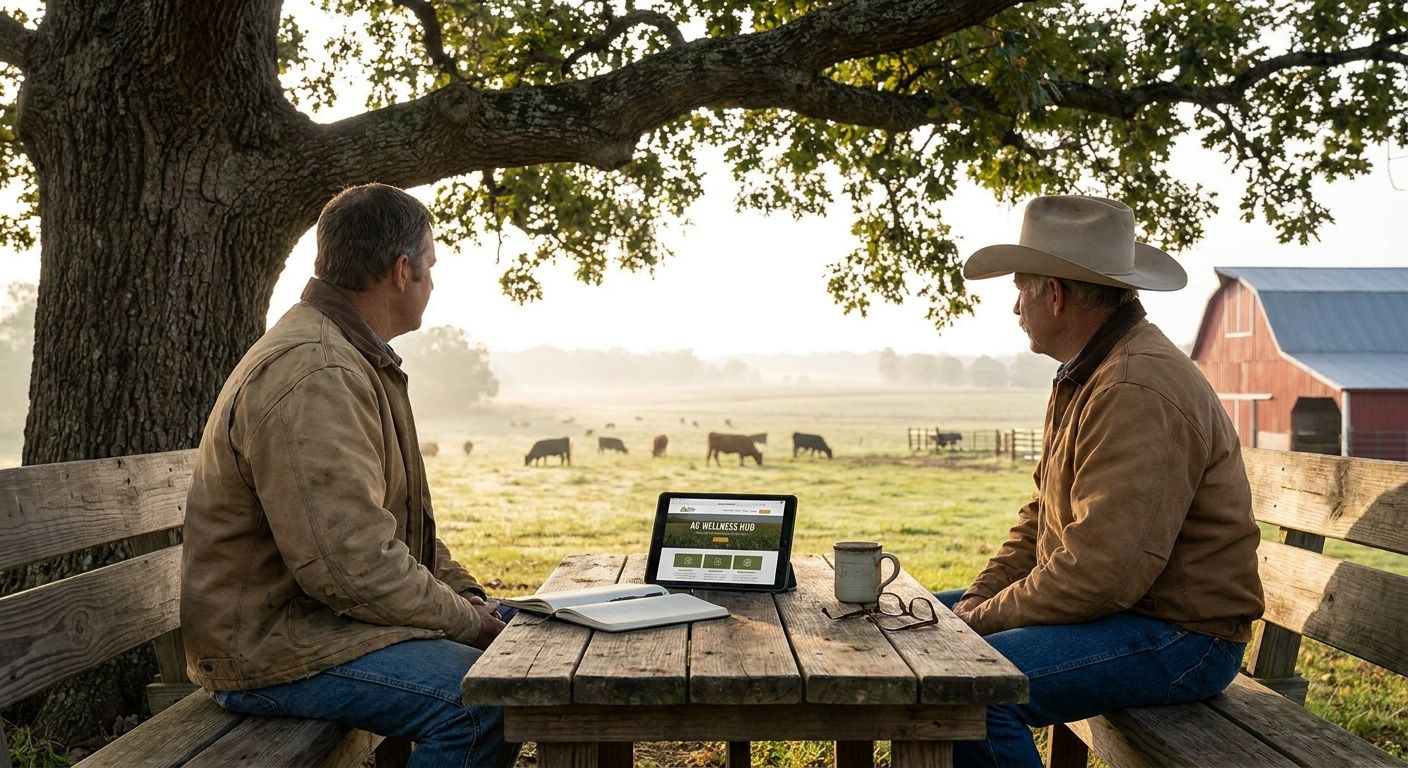
For farmers and ranchers in 2026, the best mental health resources for farmers and ranchers split into three lanes: Do More Agriculture Foundation for farm-specific outreach and education, the 9-8-8 Suicide Crisis Helpline for immediate crisis support, and individual therapy for farmers and ranchers in southern Alberta for ongoing, one-on-one work with someone who understands farm life.
- Do More Agriculture Foundation is the best overall pick for farm-specific mental health resources for farmers and ranchers in 2026.
- 9-8-8 Suicide Crisis Helpline is free, available by call or text, 24/7, anywhere in Canada.
- Alberta’s Mental Health Help Line (1-877-303-2642) connects callers to a professional at no cost, day or night.
- Ongoing counselling in southern Alberta works best when it’s booked before calving or harvest, not during it.
- Couples and premarital counselling exist specifically for farm and ranch families running a business and a marriage at the same time.
Why this matters
Farm and ranch stress doesn't look like office stress. Weather, debt load, land succession, and physical isolation all stack on top of the usual triggers, and the busiest season is usually the one with the least time to deal with any of it. A resource list that ignores that reality isn't much use to anyone running cattle or seeding wheat in 2026.
Most of the resources below are free and national. A few are local to southern Alberta and built around ongoing, one-on-one support rather than a single phone call. If the calendar is the real barrier, start by fitting therapy into a busy farming or ranching schedule before ruling counselling out entirely — most of what blocks farmers from booking is logistics, not willingness.
Stigma is still a real factor, particularly for men in farming and ranching operations who were raised not to talk about this. That's a separate problem from access, and it deserves its own resource; see therapy for men managing anxiety and depression if that's the actual sticking point.
What makes the best mental health resources for farmers and ranchers
- Understands the actual workload — seasonal swings, isolation, weather and market risk, not generic "work stress" advice
- Available outside business hours — evenings, weekends, and virtual options for anyone who can't leave the yard mid-week
- Low barrier to first contact — free crisis lines and toolkits before anyone commits to ongoing sessions
- Confidentiality in a small community — a real concern in rural Alberta where everyone knows everyone
- A path past the first call — referral onward to ongoing support, not just a one-time hotline
- Experience with farm family dynamics — succession pressure, shared business and shared marriage, in the same conversation
Mental health resources for farmers and ranchers: at a glance
| Resource | Best for | Standout feature | Key limitation |
|---|---|---|---|
| Do More Agriculture Foundation | Farm-specific mental health literacy | National, agriculture-only focus | Not a substitute for one-on-one counselling |
| 9-8-8 Suicide Crisis Helpline | Immediate crisis support | Free, 24/7, call or text | Crisis-only, no ongoing follow-up |
| Alberta Health Services Mental Health Help Line | 24/7 local Alberta access | Free, connects to a real professional | General line, not agriculture-specific |
| Individual therapy for farmers and ranchers in southern Alberta | Ongoing one-on-one counselling | Registered Psychologist familiar with farm life | Southern Alberta focus, not a crisis service |
| Couples counselling for farming and ranching families | Relationship strain tied to farm operations | Addresses business and marriage together | Requires both partners to engage |
| Canadian Mental Health Association (CMHA) Alberta Division | Community programs and workshops | Province-wide reach, established nonprofit | Less individualized than direct counselling |
| Premarital counselling for farming and ranching couples | Couples merging life and operation before marriage | Covers succession and money before the wedding | Only useful pre-wedding, not for existing conflict |
1. Do More Agriculture Foundation: best for farm-specific mental health literacy
Do More Agriculture Foundation is a Canadian nonprofit built specifically around mental health in agriculture, not general wellness content repackaged for a farm audience. It publishes free tools aimed at starting conversations on the yard or at the kitchen table, and it runs community-level programming meant to shift how farming culture talks about stress and burnout.
Do More Agriculture Foundation pros:
- Built by and for agricultural communities, not adapted from generic corporate wellness material
- Free resources, no referral or intake process required to start looking
- National reach, so it's relevant whether you're in southern Alberta or Saskatchewan
Do More Agriculture Foundation cons:
- Not a licensed counselling service — it points you toward support rather than providing therapy itself
- No crisis response function
Best for: farmers and ranchers who want to understand the problem before deciding whether to book anyone.
Verdict: use it as a starting point, not an endpoint.
2. 9-8-8 Suicide Crisis Helpline: best for immediate crisis support
The 9-8-8 Suicide Crisis Helpline is a free, national crisis line available by call or text, 24 hours a day, every day of the year, anywhere in Canada. It exists for the moment when someone needs to talk to a person right now, not for ongoing counselling.
9-8-8 pros:
- Free and available around the clock, including through calving season and harvest
- Text option works for anyone who can't safely talk out loud
- No appointment, referral, or wait required
9-8-8 cons:
- Built for crisis moments, not week-to-week support
- Doesn't replace an ongoing relationship with a therapist
Best for: anyone in immediate distress, at any hour, on any day of 2026.
Verdict: call or text it the moment things feel unmanageable — this is not the one to hesitate on.
3. Alberta Health Services Mental Health Help Line: best for 24/7 local access
Alberta's Mental Health Help Line (1-877-303-2642) connects callers directly to a mental health professional, free of charge, 24 hours a day. It's a general provincial line rather than an agriculture-specific service, but it's staffed and answered locally.
AHS Mental Health Help Line pros:
- Free, 24/7, and answered by an actual mental health professional
- Available across Alberta, including rural and remote areas
- Can help direct callers toward local follow-up options
AHS Mental Health Help Line cons:
- General mental health line, not built specifically around farm or ranch stress
- Not a crisis-specific line, though it can triage toward one
Best for: Albertans who want to talk to a real person about a non-emergency mental health concern, day or night.
Verdict: call it when you need to talk something through and 9-8-8 feels like the wrong door.
4. Individual therapy for farmers and ranchers in southern Alberta: best for ongoing one-on-one support
Individual therapy for farmers and ranchers in southern Alberta with a Registered Psychologist in Lethbridge is built around the reality that farm and ranch stress doesn't resolve in one phone call. Sessions work through anxiety, burnout, and the specific weight of running an operation where the business and the home life are the same thing.
Individual therapy for farmers and ranchers pros:
- Ongoing relationship with the same Registered Psychologist, not a rotating call centre
- Familiarity with farm and ranch pressures specific to southern Alberta
- Sessions structured around seasonal availability, not a rigid weekly template
Individual therapy for farmers and ranchers cons:
- Geographic focus on Lethbridge and southern Alberta
- Not a substitute for a crisis line in an emergency
Best for: anyone who needs sustained support beyond a single conversation, not just a one-time check-in.
Verdict: book it once the immediate crisis has passed and ongoing support is the actual need.
5. Couples counselling for farming and ranching families: best for relationship strain tied to the operation
Couples counselling for farming and ranching families addresses the specific way farm stress bleeds into a marriage — shared labour, shared debt, and disagreements about succession that never get a clean end-of-day boundary. It's a different conversation than general marriage counselling because the business and the relationship can't be separated.
Couples counselling for farming and ranching families pros:
- Treats the business partnership and the marriage as connected, not separate problems
- Addresses succession and financial conflict directly, not around the edges
- Works with both partners in the room, which matters when both run the operation
Couples counselling for farming and ranching families cons:
- Requires both partners willing to attend
- Doesn't function as individual crisis support for one partner in acute distress
Best for: couples where farm and ranch stress has become relationship stress.
Verdict: book it before resentment becomes the default tone at the supper table.
6. Canadian Mental Health Association (CMHA) Alberta Division: best for community programs and referrals
The Canadian Mental Health Association's Alberta Division is a long-established nonprofit offering community-based mental health programming and referral support across the province. It's not agriculture-specific, but it has provincial reach and existing infrastructure in most Alberta communities.
CMHA Alberta pros:
- Established, province-wide nonprofit with community programming
- Can connect people to local resources beyond a single phone call
- Runs workshops and group-based programming, useful for people who don't want one-on-one first
CMHA Alberta cons:
- General mental health focus, not built around farm or ranch stress specifically
- Less individualized than direct counselling
Best for: people who want community-based programming or a referral point rather than starting with individual therapy.
Verdict: use it if group programming or a referral is the right first step, skip it if you already know you need one-on-one work.
7. Premarital counselling for farming and ranching couples: best for couples merging life and operation before the wedding
Premarital counselling for farming and ranching couples covers the conversations that need to happen before the wedding, not after — who owns what land, how the operation gets run day to day, and what happens to the relationship when calving season eats the calendar. It's a narrower service than general couples counselling and it's meant to be used before the ring, not after a fight.
Premarital counselling for farming and ranching couples pros:
- Addresses succession and business structure before they become marital conflict
- Built specifically around farm and ranch operational realities, not generic wedding-prep topics
- Sets communication patterns before old habits set in
Premarital counselling for farming and ranching couples cons:
- Only useful before the wedding, not as a fix for existing marital conflict
- Requires both partners engaged before the date is set
Best for: engaged couples where at least one partner is bringing a farm or ranch operation into the marriage.
Verdict: book it while the wedding is still being planned, not after.
How this list was ranked
Each resource on this list was judged against the six criteria above: fit for farm and ranch reality, availability outside business hours, low barrier to first contact, confidentiality, a path beyond the first call, and actual experience with farm family dynamics. Crisis lines rank where they rank because they solve one specific problem extremely well and nothing else. Ongoing counselling ranks where it ranks because it solves a different problem — the one that's still there after the crisis call ends.
“A crisis line answers the call tonight; ongoing counselling is what keeps the next call from being necessary.”
Which mental health resource should you choose?
If something feels unmanageable right now, call or text 9-8-8. If it's a general concern and you want to talk to a professional tonight, call the Alberta Health Services Mental Health Help Line. If you're trying to understand farm-specific mental health before committing to anything, start with Do More Agriculture Foundation. And if the actual need is ongoing support — for yourself, for a marriage under farm-related strain, or for a relationship heading toward a wedding and a shared operation — that's where individual, couples, or premarital counselling in southern Alberta fits, and it's the option most farmers and ranchers put off longest in 2026.
Talk to someone who understands farm life
Individual and couples counselling for farming and ranching families in Lethbridge and southern Alberta.
FAQ
What is the best mental health resource for farmers and ranchers in 2026?
There’s no single best resource — Do More Agriculture Foundation is the best starting point for farm-specific education, 9-8-8 is the best option for immediate crisis support, and individual therapy in southern Alberta is the best option for ongoing, one-on-one work.
Is 9-8-8 free to call or text in Canada?
Yes. The 9-8-8 Suicide Crisis Helpline is free to call or text anywhere in Canada, 24 hours a day, every day of the year.
Does Alberta have a mental health helpline that isn’t just for crisis situations?
Yes. The Alberta Health Services Mental Health Help Line (1-877-303-2642) is free, available 24/7, and connects callers to a mental health professional for non-emergency concerns as well as urgent ones.
How is farm and ranch stress different from general work stress?
Farm and ranch stress combines seasonal workload, isolation, weather and market risk, and the fact that the business and the home life are usually the same operation. General workplace stress resources rarely address that overlap.
Can couples counselling help with conflict over farm succession?
Yes. Couples counselling for farming and ranching families is built specifically to address business and succession conflict alongside relationship strain, since the two usually can’t be separated.
Where can farmers and ranchers get in-person counselling in southern Alberta?
Individual therapy for farmers and ranchers in southern Alberta is available in Lethbridge, Alberta, through ongoing sessions with a Registered Psychologist familiar with agricultural life.
Is virtual counselling realistic for ranchers with unpredictable schedules?
Virtual sessions solve the distance problem for ranchers who can’t easily leave the operation, though scheduling around calving or harvest still needs to be planned ahead rather than left to the week of.
How do I bring up mental health with a farming partner who won’t talk about it?
Start with a specific resource rather than a general conversation about feelings — pointing to a concrete tool like Do More Agriculture Foundation or a specific counselling service often lands better than an open-ended check-in.
One last thing
The hardest time to book anything is exactly when it's needed most — calving in the spring, harvest in the fall. Virtual sessions solve the distance problem for farmers and ranchers in southern Alberta, but they don't solve the calendar problem. Book before the season starts, not during it, and the resource that actually gets used beats the one that only gets bookmarked.
Leave a Reply