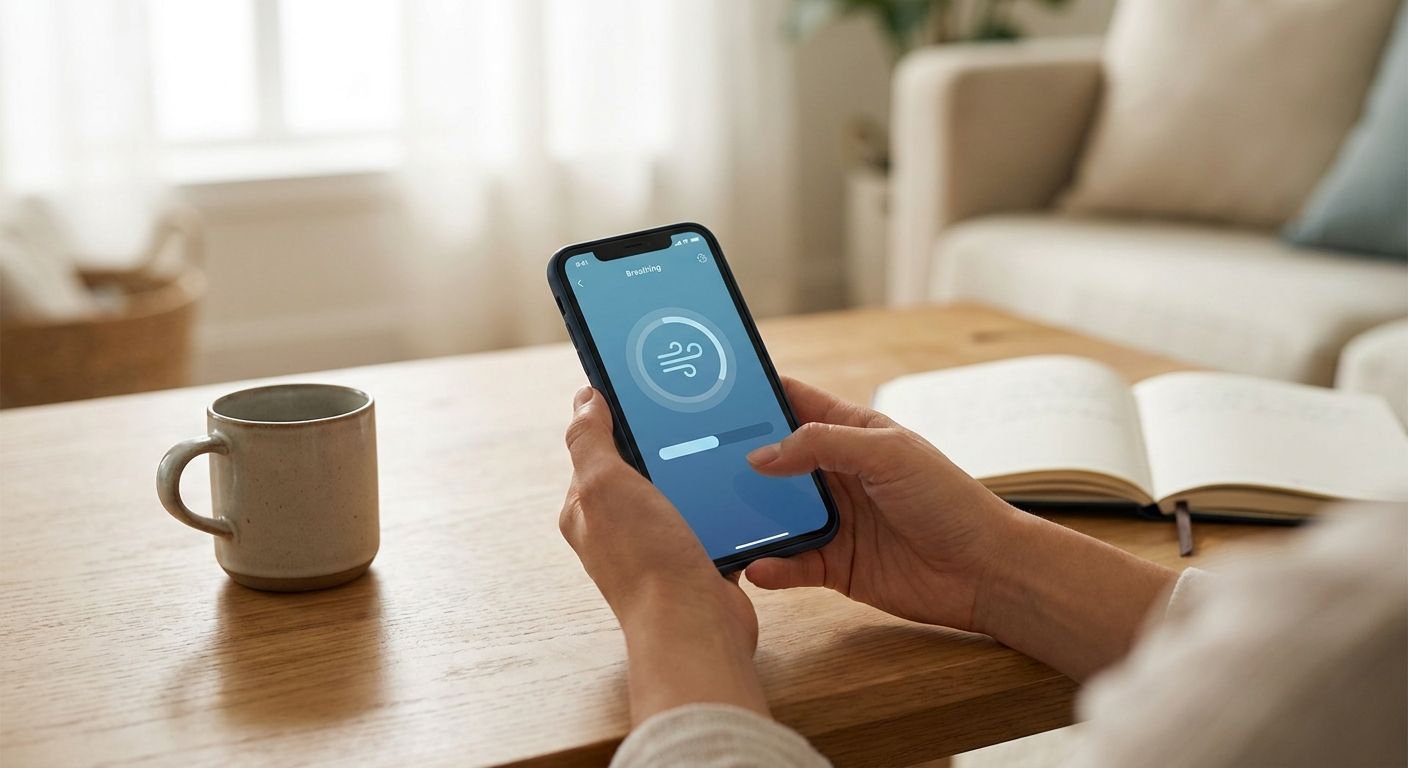
Anger management apps can teach breathing drills and thought-pattern tracking, but none of them can sit across from you and ask why the anger keeps coming back. This guide ranks the six most established anger management apps available to individuals in Canada in 2026 and tells you exactly where each one hits a wall.
- MindShift CBT wins overall for anger tied to anxiety because it teaches CBT reframing skills directly.
- Breathe2Relax is best for stopping an anger spike in the moment with guided diaphragmatic breathing.
- Sanvello is best for spotting anger patterns over weeks through daily mood tracking.
- Wysa is best for check-ins between therapy sessions using an AI-guided chat format.
- No app on this list replaces individual therapy for anger rooted in relationship conflict or unresolved trauma.
Why this matters
Anger that shows up as snapping at a partner, road rage, or a short fuse at work rarely has one cause. It's often anxiety, unprocessed grief, or a communication pattern that's been building for years. Apps are useful for the in-the-moment spike — the racing heart, the clenched jaw — but they can't unpack why the spike happens weekly instead of once a year.
In my practice as a Registered Psychologist working with individuals and couples in Lethbridge, I see anger most often as a symptom, not the root problem. A person tracking their anger in an app for three months without addressing the underlying anxiety or relationship conflict driving it usually plateaus. That's not a knock on the apps below — it's why this list treats them as a supplement, not a solution.
What makes the best anger management app
- Evidence-based technique — built on CBT, mindfulness, or physiological breathing methods with a published rationale, not vague "calm down" prompts.
- Fast access during a spike — a tool you can open in under 10 seconds when your heart rate is already climbing.
- Pattern tracking over time — logs that show you when and with whom anger shows up, not just a single-session mood check.
- No dependency on constant connectivity — works offline, since anger doesn't wait for a good Wi-Fi signal.
- Clear limits stated up front — apps that quietly position themselves as therapy replacements get ranked down; apps that point you toward professional support when needed get ranked up.
Anger management apps at a glance
| App | Best for | Standout feature | Key limitation |
|---|---|---|---|
| MindShift CBT | Anger tied to anxious thinking | Structured CBT thought-record tools | No live human support built in |
| Breathe2Relax | Interrupting an anger spike | Guided diaphragmatic breathing | Doesn't address root triggers |
| Sanvello | Tracking anger patterns over time | Daily mood and trigger logging | Requires consistent daily use to be useful |
| Wysa | Between-session check-ins | AI chatbot using CBT-style prompts | Chatbot responses can feel generic |
| Headspace | Building a lower baseline reactivity | Structured daily mindfulness courses | Slow to help during an acute spike |
| Calm | General stress and sleep support | Breathing exercises and sleep stories | Not built specifically for anger |
1. MindShift CBT: best anger management app for anxiety-driven anger
MindShift CBT, developed by Anxiety Canada, uses cognitive behavioural therapy techniques to help you catch and reframe the anxious thoughts that often precede an anger outburst. It walks you through identifying a trigger, naming the thought behind it, and testing whether that thought holds up.
MindShift CBT pros:
- Structured CBT thought-record exercises you can complete in a few minutes
- Built by a Canadian mental health organization, so the content matches how CBT is taught in Canadian clinical practice
- Works well as a between-session tool if you're already in therapy
MindShift CBT cons:
- No live coaching or human support
- Aimed primarily at anxiety, so anger that isn't anxiety-driven gets less direct coverage
- Requires you to actually sit down and write, which is hard mid-argument
Best for: people whose anger is a downstream reaction to anxious or catastrophic thinking. Verdict: recommended as a daily companion tool, not a stand-alone fix.
2. Breathe2Relax: best anger management app for stopping a spike in the moment
Breathe2Relax was developed by the U.S. National Center for Telehealth & Technology to teach diaphragmatic breathing for stress and anger regulation. It's built for exactly one job: slowing your physiological response down fast enough that you don't say something you regret.
Breathe2Relax pros:
- Simple, guided breathing pacer with almost no learning curve
- Works offline, which matters when the spike hits somewhere with no signal
- Physiologically grounded — slower, deeper breathing measurably lowers heart rate
Breathe2Relax cons:
- Doesn't touch the underlying trigger or pattern
- No tracking or long-term insight into your anger history
- Can feel too simple if you've already mastered basic breathing techniques
Best for: the ten seconds right before you'd normally raise your voice. Verdict: recommended as a first-response tool.
3. Sanvello: best anger management app for tracking patterns over weeks
Sanvello (formerly Pacifica) combines CBT-based tools with daily mood tracking, letting you log anger episodes alongside sleep, stress, and other factors. Over several weeks, the logs start showing whether your anger clusters around certain days, people, or times.
Sanvello pros:
- Daily tracking builds a real dataset of your own patterns
- Combines mood tracking with CBT coping tools in one place
- Useful data to bring into a therapy session if you're seeing a counsellor
Sanvello cons:
- Only useful if you log consistently — sporadic use gives you nothing to analyze
- Tracking alone doesn't resolve conflict with the people involved
- Can feel like homework on a bad day, which is exactly when you're least likely to open it
Best for: people who want data before deciding whether the anger is situational or a bigger pattern. Verdict: recommended if you'll actually use it daily.
4. Wysa: best anger management app for between-session support
Wysa is an AI chatbot that walks users through CBT-style prompts when they're struggling with stress, anxiety, or anger. It's designed to feel like a conversation rather than a static worksheet, which lowers the barrier to actually opening the app when you're upset.
Wysa pros:
- Conversational format is easier to use mid-crisis than a form or worksheet
- Available any time of day or night
- Can prompt reflection questions you might not think to ask yourself
Wysa cons:
- Chatbot responses are pattern-based and can feel repetitive or generic
- Not a substitute for a therapist who knows your relationship history
- No accountability to follow through on insights it surfaces
Best for: the 2 a.m. moment when you're too wound up to sleep but don't want to wake anyone. Verdict: useful as a supplement between real therapy sessions.
5. Headspace: best anger management app for lowering baseline reactivity
Headspace's structured meditation courses focus on building a calmer baseline over time rather than solving an acute spike. Consistent use is associated with lower overall reactivity, which means fewer triggers escalate to full anger in the first place.
Headspace pros:
- Structured courses with a clear beginning-to-end progression
- Broad content library covering stress, sleep, and focus, not just anger
- Easy for beginners with no meditation background
Headspace cons:
- Too slow to help in an active spike — this is a long game, not a fire extinguisher
- General wellness focus means anger-specific content is limited
- Requires daily consistency to see the baseline shift
Best for: someone whose anger runs at a low simmer most days rather than sudden spikes. Verdict: worth trying as a long-term habit, not an emergency tool.
6. Calm: best anger management app for general stress and sleep support
Calm is a broad stress-and-sleep app with breathing exercises, sleep stories, and guided meditations. It isn't built specifically for anger, but poor sleep and chronic stress both feed shorter fuses, so improving either one indirectly helps.
Calm pros:
- Wide library of breathing and relaxation content
- Sleep-focused tools address a common anger amplifier — exhaustion
- Familiar, well-established interface with a low learning curve
Calm cons:
- Not built with anger-specific frameworks or tracking
- Content breadth means less depth on any single technique
- Easy to use passively without building real skill
Best for: people whose anger is worsened by poor sleep and general stress rather than one identifiable trigger. Verdict: a reasonable add-on, not a core anger tool.
How we ranked these apps
Each app was weighed against the five criteria above: technique quality, speed of access during a spike, pattern tracking, offline reliability, and honesty about its own limits. Apps built specifically around CBT or physiological breathing (MindShift CBT, Breathe2Relax) scored higher on technique quality than general wellness apps (Calm, Headspace), which is why they lead the ranking despite Calm and Headspace having larger overall content libraries.
“An app can teach you to breathe through a spike; it can’t tell you why the spike happens every Sunday night before your ex drops the kids off.”
Which anger management app should you choose in 2026?
If your anger is tied to anxious or catastrophic thinking, start with MindShift CBT. If you need something for the exact moment your jaw clenches, keep Breathe2Relax on your home screen. If you want data before deciding whether this is a pattern or a bad month, run Sanvello for two to three weeks and look at what it shows you.
What none of these apps will do is sit with you and ask why the same fight keeps happening with the same person. If your anger is showing up most in a relationship — snapping at a partner, going silent instead of talking, or feeling like every disagreement turns into a blow-up — that's a conversation for a therapist, not an app. If the anger surfaces most at work or in daily life rather than a relationship, individual therapy built around CBT can address the anxiety or thought patterns underneath it directly.
Ready to address what’s under the anger?
Book an individual therapy session with a Registered Psychologist in Lethbridge.
FAQ
What is the best anger management app for 2026?
MindShift CBT ranks best overall for 2026 because it uses structured cognitive behavioural therapy exercises to catch and reframe the thoughts that trigger anger. It works best for anger tied to anxious or catastrophic thinking rather than anger rooted in a specific relationship conflict.
Can an app actually help with anger management?
Apps can help interrupt an anger spike in the moment and help you track patterns over time, but they don’t address why the anger keeps recurring. For anger tied to relationship conflict or unresolved trauma, a therapist offers a level of insight an app can’t replicate.
Is Breathe2Relax better than MindShift CBT for anger?
They solve different problems. Breathe2Relax is faster for stopping an active anger spike through guided breathing, while MindShift CBT is better for the slower work of identifying and reframing the thoughts driving your anger over time.
How much do anger management apps cost?
Pricing and plan structures change frequently, so check the current listing on each app’s store page before downloading. Compare the free features against what’s locked behind a subscription before committing.
Do anger management apps work for relationship anger specifically?
Apps track your own patterns but can’t mediate a live conflict between you and a partner. If the anger consistently surfaces during disagreements with a partner, couples counselling addresses the dynamic directly in a way a solo app cannot.
How long does it take for an anger management app to work?
Apps built around daily tracking or mindfulness, like Sanvello or Headspace, generally need several consistent weeks before patterns or a lower baseline reactivity become noticeable. Breathing apps like Breathe2Relax work within minutes for an acute spike but don’t build long-term change on their own.
When should I see a therapist instead of using an app for anger?
See a therapist when the anger is affecting a relationship, showing up weekly or more, or when you’ve noticed apps helping in the moment but the same triggers keep coming back. A therapist can address the root cause an app is only managing the surface of.
Are anger management apps a substitute for therapy?
No app on the market in 2026 replaces individual therapy for anger with a clear underlying cause. Apps work best as a between-session supplement alongside professional support, not as a stand-alone treatment.
One last thing
The apps on this list that score highest — MindShift CBT and Breathe2Relax — both work because they're narrow. They do one job well instead of trying to be a full wellness platform. If you download an anger app in 2026 and find yourself still reaching for it after three months with no change in how often the anger happens, that's not a sign to switch apps. It's the signal that the trigger is bigger than an app was ever built to handle.
Related guides
- Mindfulness apps for stress management
- Relaxation techniques for reducing chronic stress
- Setting healthy boundaries in a relationship
Leave a Reply